

You’ve noticed your young adult is struggling. They seem anxious. They’re withdrawn. They’re avoiding situations. But you don’t know how to bring it up. You’re afraid they’ll get defensive. You’re worried you’ll say the wrong thing and make it worse. So you stay silent. And the problem continues.
Having a conversation about anxiety and mental health with your young adult feels risky. You might upset them. They might shut down. They might deny anything is wrong. But avoiding the conversation is riskier. It leaves your teen struggling alone, thinking no one notices or cares.
The right conversation can change everything. It opens a door to understanding. It lets your young adult know you see them and want to help. It creates space for them to ask for support. And it might be the catalyst that leads them to anxiety and depression treatment centers or residential treatment for anxiety and depression if that’s what they need.
This article walks you through how to start the conversation, what to say and what not to say, how to listen effectively, and when to recommend professional help.
What Is Anxiety, Really?
Anxiety is your body’s alarm system firing when there’s no real danger present. It shows up as constant worry, a racing heart, trouble sleeping, or a young adult who suddenly avoids things they used to handle fine: a job interview, a college class, even a phone call.
For some young adults it’s occasional and manageable. For others it’s persistent enough to stop them from moving forward with their lives. The difference between everyday stress and an anxiety disorder usually comes down to duration and impact. If it’s lasting weeks and interfering with daily function, it’s no longer just stress.
Preparing Yourself for the Conversation
Before you talk to your young adult, prepare yourself.
Check your own emotions. If you’re angry, scared, or frustrated, your young adult will feel it. Take time to calm down first. This conversation is about them, not about your feelings.
Get clear on your goal. You’re not trying to diagnose them. You’re not trying to force them into treatment. You’re trying to open a conversation and express care. That’s it.
Educate yourself. Read about anxiety symptoms. Understand that anxiety and depression are real, not character flaws. If you approach the conversation from judgment, they’ll shut down. If you approach it from understanding, they might open up.
Avoid assumptions. You think you know what’s happening. You might be wrong. Listen to understand, not to confirm what you already think.
Have resources ready. Know where to find mental health services in your area. If your young adult says yes to help, you can move quickly. Anxiety and depression treatment centers exist locally and nationally. You don’t need to know everything, but knowing where to look helps.
Signs Your Young Adult May Be Struggling
You already sense something is off. Here’s what that usually looks like in practice:
- Withdrawing from friends, activities, or conversations they used to enjoy
- Sleeping far more or far less than usual
- Avoiding responsibilities: job applications, school deadlines, even leaving the house
- Getting defensive or irritable over small requests
- Physical complaints with no clear cause, like stomachaches, headaches, or fatigue
- Spending most of their time alone in their room, often on a screen
- Expressing hopelessness about the future: “what’s the point” or “nothing will change”
None of these on their own means your young adult has an anxiety disorder. Together, and lasting more than a few weeks, they’re a signal that a conversation, and possibly professional support, is overdue.
How to Start the Conversation
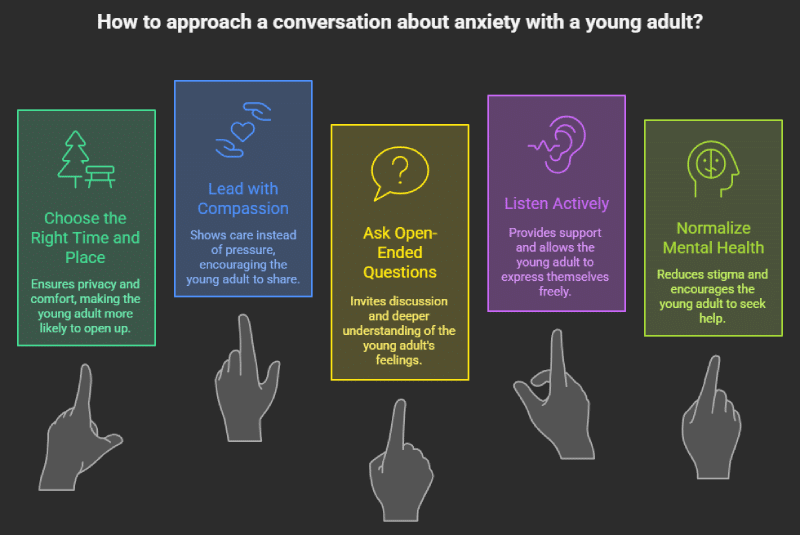
There’s no perfect opening line. But here are approaches that work:
The observation approach:
“I’ve noticed you seem more stressed lately. You’re staying in your room more. You seem worried. I wanted to check in and see how you’re doing.”
This is gentle and specific. You’re not diagnosing. You’re just noticing and asking.
The care approach:
“I care about you. I’ve been worried. You don’t seem like yourself. Can we talk about what’s going on?”
This is direct but warm. Your young adult knows you care, not that you’re judging.
The curiosity approach:
“How are you really doing? Not the surface answer, but how are you actually feeling?”
This gives your young adult permission to go deeper.
The admission approach:
“I don’t know exactly what’s going on, but I know something is. I’m here. Tell me what you need.”
This acknowledges that you don’t have all the answers and puts the focus on what your young adult needs.
The indirect approach:
If direct doesn’t work, bring it up during an activity. A drive. A walk. Washing dishes together. Sometimes young adults talk more easily when they’re not sitting face-to-face.
/therapeutic-approach-young-adults/What to Say: The Right Language
Once you’ve opened the conversation, stay away from judgmental language. This shuts down communication fast.
Don’t say:
“Are you lazy?” or “Why won’t you just try?”
“You’re being difficult.”
“Everyone deals with stress. Just get over it.”
“You’re too sensitive.”
“You need to pull yourself together.”
These statements sound like judgment and blame. Your young adult hears: You’re the problem. You’re weak. You’re not trying hard enough.
Do say:
“I see you’re struggling. That’s real, and I want to help.”
“Anxiety is not something you can just overcome by willpower. It might need professional help.”
“I believe you. What you’re feeling is valid.”
“I don’t fully understand what you’re going through, but I want to learn.”
“You’re not alone in this. We’ll figure it out together.”
These statements validate their experience. They show you believe them. They open space for honesty.
Listen More Than You Speak
Here’s where many parents get it wrong. They ask a question, their young adult starts to answer, and the parent interrupts with advice or judgment.
Listen actively:
Ask a question. Then actually listen to the answer. Don’t prepare your response while they’re talking. Don’t interrupt. Let silence sit. Sometimes young adults need quiet space to think through what they’re feeling.
Ask follow-up questions:
“Tell me more about that.”
“How long has this been happening?”
“How is it affecting your daily life?”
“What makes it worse? What helps?”
These questions show you’re genuinely interested. They help you understand what’s actually happening.
Avoid fixing:
Your young adult tells you they’re anxious about getting a job. Your first instinct is to fix it. “You should apply here.” “I know someone who can help.” “It’s not that bad.”
Instead, listen first. “That sounds really hard. Tell me more about what you’re worried about.” Once you understand, you can offer suggestions. But listen first.
Watch their body language:
Is your young adult open or closed off? Do they seem willing to keep talking? Are they getting defensive? Adjust your approach based on what you see. If they’re closing down, give them space. “We don’t have to talk about this right now. But I’m here whenever you’re ready.”
The Conversation Flow: From Problem to Solutions
Here’s how a conversation might flow once you’ve started it:
| Stage | What to Do | Example |
|---|---|---|
| Opening | Observe and ask with care | “I’ve noticed you seem anxious. How are you really doing?” |
| Listening | Let them share without interrupting | They explain what they’re experiencing |
| Validation | Confirm their experience is real | “That sounds really difficult. I believe you.” |
| Understanding | Ask questions to understand better | “When did this start? How often does it happen?” |
| Reflection | Show you understand | “So you’re anxious about decisions and avoiding trying new things.” |
| Exploration | Ask what they think would help | “What do you think might help you feel better?” |
| Problem-solving | Together, identify next steps | “Would you be open to talking to a professional?” |
This flow respects your young adult’s experience while moving toward solutions.
When to Recommend Professional Help
Sometimes the conversation leads to a clear need for professional support. Watch for these signs:
Your young adult:
- Admits they’re struggling and feeling out of control
- Says their mental health is affecting their daily life
- Asks for help or is open to getting help
- Shows symptoms of anxiety or depression persisting for weeks or months
- Is expressing thoughts of self-harm or suicide
If There’s Any Mention of Self-Harm
Treat this differently than the rest of the conversation. If your young adult says anything that sounds like self-harm or suicide, even something vague or said in passing, don’t wait for a better moment.
Call or text 988 (the Suicide & Crisis Lifeline) together, or reach the Crisis Text Line by texting HOME to 741741. Both are free, confidential, and available 24/7. If you believe your young adult is in immediate danger, call 911 or go to the nearest emergency room.
This isn’t about overreacting. It’s about taking what they said seriously enough to act on it right away, and letting them know you’re taking it seriously too.
When you see these signs, suggest professional help immediately.
How to suggest it:
“Based on what you’ve told me, I think talking to a professional would help. This is beyond what I can support alone. Would you be willing to try therapy?”
If they say yes, move quickly. Contact a therapist or psychiatrist. If anxiety is moderate to severe or affecting their ability to function (inability to work, leave home, maintain relationships), anxiety and depression treatment centers or residential treatment for anxiety and depression might be appropriate.
If they say no:
“I hear you. But I’m still concerned. I’m going to set up an appointment with a professional. You can decide whether you want to go, but I think it’s important.”
You can’t force your young adult into treatment (if they’re over 18). But you can express that you think it’s necessary. Plant the seed. They might surprise you and become willing later.
What Professional Support Can Look Like
“Professional help” isn’t one thing, and knowing the range makes the conversation easier because you can describe real options instead of a vague next step.
For many young adults, outpatient therapy is enough: weekly sessions with a licensed therapist who specializes in anxiety, sometimes paired with a psychiatrist for medication management. This works well when your young adult is still going to work or school and just needs consistent support to build coping skills.
When anxiety has stalled someone’s life (they’ve stopped working, stopped leaving the house, stopped functioning day to day), outpatient therapy alone often isn’t enough. That’s where a structured therapeutic approach built specifically for young adults comes in: individual therapy, life skills coaching, and real-world practice, so progress made in a session actually transfers to daily life.
For young adults who need more than weekly appointments, a residential program provides daily structure, therapeutic support, and a community of peers working through similar struggles, all in one place. It’s a bigger step, and it’s usually reserved for when anxiety has become severe enough to interfere with basic functioning.
None of these paths require you to have all the answers today. They just require knowing they exist so you can bring them up if your young adult is open to more support.
Real-World Example: A Conversation That Works
Marcus’s mom reaches out:
Mom: “I want to talk to you about something I’ve noticed. You’ve been staying in your room a lot lately, and you haven’t gone out with your friends in weeks. I’m worried. How are you actually doing?”
Marcus: “I’m fine. Just tired.”
Mom: “I hear that you’re tired. But it seems like more than that. Talk to me. What’s going on?”
Marcus: (After a pause) “I don’t know. Everything feels overwhelming. Getting a job, moving out, all of it. I don’t think I can do it.”
Mom: “That sounds really scary. Tell me more about what makes it feel overwhelming.”
Marcus: “I’m afraid I’ll mess up. I’ll get a job and fail. I’ll move out and can’t handle it. Everything feels impossible.”
Mom: “I can see why that feels scary. Those are big concerns. But I also know you’re capable of more than you think. Have you talked to anyone professional about these feelings?”
Marcus: “No.”
Mom: “I think talking to a therapist might help. You’re not struggling alone. Would you be open to trying therapy?”
Marcus: “I guess.”
Mom: “I’ll set up an appointment. We’ll figure this out together.”
This conversation works because:
- Mom observed and asked with care
- She listened without fixing
- She validated Marcus’s feelings
- She moved toward professional help when appropriate
- She didn’t blame or judge
When Anxiety and Substance Use Overlap
Anxiety and substance use often show up together in young adults, and it’s worth watching for. Alcohol or marijuana can feel like relief in the moment: it quiets the racing thoughts, makes social situations easier, helps someone sleep. But it’s a short-term fix that tends to make anxiety worse over time, and it can turn into its own problem separate from the anxiety that started it.
If you notice your young adult drinking more than usual, using substances to get through ordinary situations, or getting defensive when you bring up their use, that’s worth naming directly and without judgment. “I’ve noticed you’ve been drinking more when you’re stressed. I’m not trying to accuse you of anything, I just want to understand what’s going on.”
When anxiety and substance use are tangled together, treating one without the other rarely works. A program built to address both at once, like the substance abuse treatment programs designed for young adults we offer, gives your young adult a better shot at addressing the anxiety underneath the substance use instead of just managing one symptom while the other keeps building.
What Happens After the Conversation
Once you’ve opened the conversation and your young adult is open to help:
Follow through. If you said you’d find a therapist, do it. Don’t let it drop.
Support them getting help. Sometimes young adults agree to therapy but then resist. Keep encouraging. “I know this is hard. I’m proud of you for trying.”
Don’t push too hard. There’s a balance between encouragement and pressure. Too much pressure backfires.
Consider professional evaluation. A therapist can recommend whether outpatient therapy is enough or whether anxiety and depression treatment centers or residential treatment for anxiety and depression would be more helpful.
Do your own work. Many parents benefit from family therapy. It helps you understand your role and support your young adult better.
Family Dynamics: Why Your Whole Household’s Wellbeing Matters
Your young adult’s anxiety doesn’t exist in isolation. It’s shaped by, and shapes, everyone else in the house, including siblings who may be absorbing more of the tension than they let on.
Research backs this up: siblings of a young adult dealing with chronic illness or dysfunction face roughly double the risk of developing mental illness themselves, often because household stress, shifted attention, and unspoken tension affect everyone, not just the person struggling most visibly.
That doesn’t mean you need to fix everything at once. It means checking in with your other kids too, even briefly. “I know things have been tense at home. How are you doing with all of it?” A short conversation like that can catch a second struggling young adult before it becomes a second crisis.
Family therapy, mentioned earlier, is built for exactly this: giving every member of the household space to be heard, not just the one whose struggle is most visible.
Next Steps: Starting the Conversation
You don’t need to be perfect. You just need to show you care and you want to understand.
Here’s your action plan:
Step 1: Pick a calm time. Not during conflict. Not when you’re stressed.
Step 2: Prepare yourself emotionally. Check your judgment. Commit to listening.
Step 3: Start the conversation. Use one of the approaches above. Be genuine.
Step 4: Listen more than you speak. Let your young adult be heard.
Step 5: Validate their experience. Even if you don’t fully understand, show you believe them.
Step 6: Move toward solutions. If professional help is needed, suggest it.
Step 7: Follow through. If they say yes to therapy or evaluation, make it happen.
Contact At The Crossroads to help your teen now. Call (866) 439-0354 or email info@atthecrossroads.com. If your young adult’s anxiety or mental health struggles are severe, our anxiety and depression treatment centers can provide comprehensive evaluation and care. Whether outpatient therapy or residential treatment for anxiety and depression is needed, we can help you understand the best path forward. We also work with families to improve communication and support. 24/7 confidential consultations available.
Your conversation might be the turning point. It might be what your young adult needs to ask for help. Start today.
Questions You Might Have
What if my young adult gets angry or defensive when I bring it up?
That’s actually normal. Defensiveness often comes from shame or fear. They know something’s wrong but feel embarrassed. Instead of backing down when they get defensive, stay calm and compassionate. “I see you’re upset. That’s okay. I’m not trying to judge you. I’m worried about you, and I want to understand what’s going on.”
How do I know if my young adult will be open to the conversation?
Timing and approach matter more than you’d think. Choose a calm moment, not during conflict. Do it one-on-one. Use an indirect approach if direct doesn’t work. Ask about their feelings during a car ride or a walk. Sometimes young adults open up more easily when they’re not making direct eye contact.
What if they refuse to talk or deny anything is wrong?
Plant the seed anyway. “I’ve noticed you seem stressed. Whenever you’re ready to talk, I’m here.” Then give them space. Sometimes young adults need time to process before they’re willing to talk. You’ve opened the door. They’ll come through when they’re ready, or they might seek help from someone else, which is still progress.
How long should I wait before bringing it up again if the first conversation doesn’t go well?
Give it a few days, not a few months. A short cooling-off period lets the initial defensiveness fade, but waiting too long can read as giving up. Bring it up again casually: “I’ve been thinking about what we talked about. I still want to understand what’s going on when you’re ready.”
Should I talk to my young adult’s siblings about what’s happening?
Usually yes, in an age-appropriate way. Siblings often already sense something is wrong, and staying silent can leave them anxious or confused about their own role in it. A brief, honest update, without oversharing details your young adult hasn’t consented to, helps the whole household feel less on edge.
Recent Comments