

You watch your young adult struggle with basic tasks that seem simple to you. Maybe they can’t manage money, cook a meal, or hold a job for more than a few weeks. Or perhaps they’re stuck at home, avoiding responsibility while anxiety or depression keeps them paralyzed. If this sounds familiar, you’re not alone. Parents across the United States are watching their children get stuck in what’s commonly called failure to launch, and it’s exhausting to witness.
The real problem isn’t laziness or entitlement. Most young adults who struggle with independence are missing fundamental life skills combined with mental health challenges, lack of confidence, or no clear path forward. Life skills programs for young adults address this gap head-on. These programs teach practical abilities and rebuild the self-reliance your teen needs to move into adulthood with real confidence, not just forced effort.
At At The Crossroads, a young adult transitional living program based in St. George, Utah, we’ve spent years helping teens from across the country develop these skills in a safe, structured environment. This article breaks down the 10 essential life skills your young adult needs to learn, and why a quality life skills program might be the turning point your family has been waiting for.
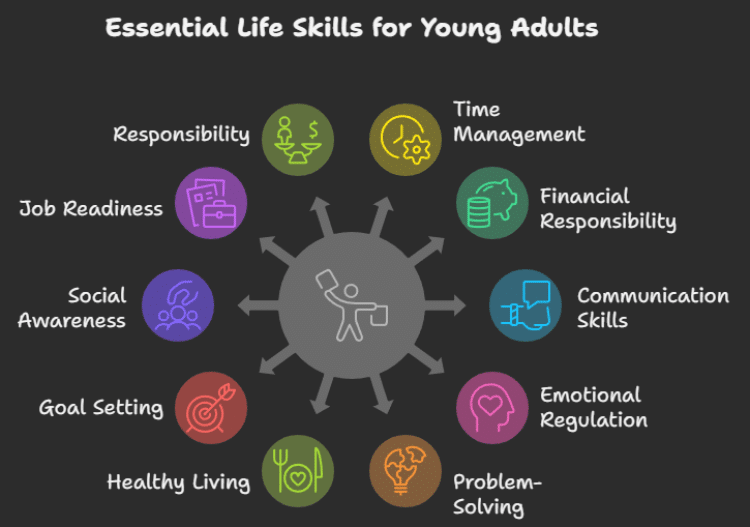
The 10 Essential Life Skills Every Young Adult Needs
1. Financial Management and Budgeting
This is perhaps the most critical life skill. Your teen needs to understand money from every angle.
What it includes:
- Creating and following a budget
- Tracking spending and identifying where money goes
- Saving for short-term and long-term goals
- Understanding credit, debt, and interest rates
- Paying bills on time
- Making informed spending decisions
Why it matters: Young adults stuck in failure to launch often have zero understanding of how to manage money. They either blow through cash without thinking or feel so overwhelmed by financial responsibility that they avoid it entirely. This keeps them dependent on parents indefinitely.
Studies show that financial stress is a leading cause of anxiety in young adults. When your teen learns to manage money, they reduce stress, build self-efficacy, and take a major step toward independence.
2. Cooking and Meal Preparation
Cooking goes far beyond just making food. It teaches planning, safety, budgeting, and self-care.
What it includes:
- Meal planning and grocery shopping on a budget
- Basic food safety and kitchen hygiene
- Preparing simple meals from scratch
- Understanding nutrition and making healthy choices
- Cleaning up and maintaining a kitchen space
Why it matters: Many young adults in failure-to-launch situations have never cooked a full meal. They rely on takeout, frozen food, or parents to feed them. This creates dependency and sends the message that they can’t care for themselves. Learning to cook rebuilds confidence and independence while improving nutrition and reducing food costs.
A young adult who can plan, shop, prepare, and clean up a meal has demonstrated responsibility, planning, and follow-through in a single activity.
3. Household Management and Cleaning
Living independently means maintaining a clean, functional space.
What it includes:
- Basic cleaning routines (bathroom, kitchen, floors)
- Laundry management, including washing, drying, and folding
- Organizing personal space and possessions
- Basic home maintenance tasks
- Understanding when to ask for professional help
Why it matters: Many parents find their young adult’s room or living space deteriorating into chaos. This isn’t always about laziness. Often it reflects depression, executive dysfunction, or simply never having learned the habit. Household management skills build independence and directly impact mental health. A clean space reduces anxiety and sends the signal, “I can take care of myself.”
4. Time Management and Organization
Executive function skills are critical for any adult task.
What it includes:
- Creating and using a calendar or planner
- Breaking large tasks into manageable steps
- Setting priorities and meeting deadlines
- Understanding the connection between time and consequences
- Building daily and weekly routines
Why it matters: Young adults with ADHD, anxiety, or depression often struggle with time management. They miss appointments, fail to start important tasks, or get so overwhelmed they do nothing. Without this skill, holding a job or managing school becomes nearly impossible. Time management training gives structure to the day and prevents the paralysis that comes from feeling lost.
5. Job Search and Employment Skills
Getting and keeping a job is one of the strongest predictors of adult success.
What it includes:
- Building a resume and cover letter
- Practicing interview skills
- Understanding workplace norms and expectations
- Learning how to take feedback without becoming defensive
- Developing workplace social skills and communication
- Problem-solving on the job
- Understanding taxes, paychecks, and employment benefits
Why it matters: Career development support helps build a sense of capability at work, which often spills into other areas of life. Many struggling young adults avoid job searching because they fear failure or rejection. Programs that provide hands-on job coaching, interview practice, and job placement support lower this barrier significantly. Once they land a job and stick with it, they build the confidence to tackle other adult responsibilities.
6. Communication and Social Skills
Healthy relationships and successful work interactions require solid communication.
What it includes:
- Active listening and asking clarifying questions
- Expressing needs and boundaries respectfully
- Conflict resolution without aggression or avoidance
- Making and maintaining friendships
- Professional communication in work settings
- Understanding social cues and appropriate behavior
- Asking for help when needed
Why it matters: Young adults stuck in failure to launch often isolate themselves, avoiding both peer relationships and authority figures. This isolation deepens depression and prevents skill-building through natural social interaction. Social skills coaching helps break this cycle by teaching them how to engage with others without excessive anxiety.
7. Health and Wellness Maintenance
Physical and mental health are foundational to all other life skills.
What it includes:
- Personal hygiene routines (shower, dental care, grooming)
- Regular exercise and physical activity
- Nutrition and healthy eating habits
- Sleep hygiene and managing sleep schedules
- Recognizing signs of physical or mental health problems
- Managing medications if prescribed
- Understanding when to see a doctor
Why it matters: Depression and anxiety often show up as neglect of basic self-care. A young adult who stops showering, loses sleep, or eats poorly is sending a red flag that their mental health is deteriorating. Building wellness habits reinforces self-respect and directly improves mood and energy. Programs like At The Crossroads emphasize wellness as part of the overall structure.
8. Decision-Making and Problem-Solving
Life requires making choices and handling unexpected challenges.
What it includes:
- Identifying a problem and defining what needs to be solved
- Gathering information and considering options
- Weighing pros and cons
- Making a decision and following through
- Evaluating the outcome and learning from mistakes
- Asking for input without becoming dependent on others’ answers
Why it matters: Fear of failure and perfectionism often paralyze young adults in failure to launch. They become stuck because they can’t decide, worry about making the wrong choice, or expect a perfect solution that doesn’t exist. Problem-solving training teaches them that most decisions are reversible and that trying and failing is how adults learn.
9. Money Management Beyond Budgeting
Deeper financial literacy prepares young adults for real-world situations.
What it includes:
- Understanding different types of debt (credit cards, student loans, car loans)
- Building and protecting credit scores
- Recognizing predatory financial practices
- Basic investing and retirement planning
- Understanding insurance (health, car, renters)
- Tax basics and what to expect from W-2s and 1099s
Why it matters: Young adults who understand how credit and debt work make better decisions early on. Getting into credit card debt or defaulting on student loans derails independence for years. Teaching financial literacy prevents costly mistakes and builds long-term wealth.
10. Emotional Regulation and Stress Management
This is the foundation that supports all other skills.
What it includes:
- Recognizing emotions and what triggers them
- Learning calming techniques (breathing, grounding, mindfulness)
- Tolerating difficult emotions without acting destructively
- Managing anxiety in work or social situations
- Building resilience after setbacks
- Knowing when to reach out for mental health support
Why it matters: Anxiety is often at the core of failure to launch. Without emotional regulation skills, your young adult remains stuck in avoidance. They can’t start job searching because anxiety overwhelms them. They can’t move out because the fear feels unbearable. Teaching them to manage emotions directly removes the biggest barrier to independence.
Life Skills Programs for Young Adults: What Makes Them Work
Not all programs are equal. The best life skills programs for young adults combine three essential elements:
| Element | What It Includes | Why It Matters |
|---|---|---|
| Therapeutic Support | Individual and family therapy addressing mental health barriers (anxiety, depression, trauma) | Removes the emotional blocks that prevent young adults from trying |
| Structured Skill Training | Hands-on coaching in budgeting, cooking, job skills, daily living | Builds competence and confidence through practice in a safe space |
| Accountability and Real-World Practice | Young adults live in the program, practice skills daily, face natural consequences | Skills stick when practiced in context, not just discussed in a classroom |
At The Crossroads provides all three. Our young adult transitional living program combines licensed clinical therapy, vocational training, life skills coaching, and outdoor activities. Young adults live on-site, learning life skills through daily structure and real practice, not theory.
Why Your Teen Might Be Struggling: Common Barriers to Life Skills Development
Understanding why your young adult hasn’t developed these skills is crucial for choosing the right support.
Untreated Mental Health Issues – Anxiety, depression, ADHD, and past trauma create internal barriers that make learning new skills feel impossible.
Overprotective Parenting – When parents step in too often to solve problems or rescue from discomfort, their teen never builds the skills or confidence to handle challenges.
Limited Opportunity – Some young adults simply haven’t been taught these skills or given chances to practice them.
Fear of Failure – Perfectionism and fear of embarrassment keep them from trying new things.
Lack of Motivation or Direction – Without a clear goal, young adults lack the push to develop skills they don’t see as immediately relevant.
A quality life skills program addresses these root causes alongside the actual skill gaps.
The Benefits of a Structured Life Skills Program
When you choose a failure-to-launch program, you’re investing in transformation. Here’s what typically happens:
Immediate Benefits:
- Your teen starts managing daily responsibilities independently
- Mental health symptoms often improve with structure and support
- Family conflict decreases as boundaries become clear
- Your teen experiences small wins that build confidence
Long-Term Benefits:
- Your young adult moves toward independent living and employment
- They develop the resilience to handle life’s challenges
- They build a support network beyond their parents
- Your family relationships improve as dependence decreases
Research shows that life skills training boosts self-efficacy in young adults, meaning they start believing in their own ability to achieve goals. This belief is transformative.
Local Support in St. George, Utah and Beyond
If you’re considering a life skills program for your young adult, location matters. At The Crossroads is based in St. George, Utah, but we accept young adults from across the United States. Our program integrates with local resources, outdoor recreation, and community connections that support growth.
Whether you’re in Washington County, Utah or sending your teen from across the country, our team provides the same level of care and commitment. We combine therapeutic support, life skills training, and real-world practice in a community designed to help young adults launch.
What Comes After the Program: Aftercare and Support
A good program doesn’t end when your teen leaves. Aftercare support helps transition back home or to independent living while preventing relapse into old patterns.
At The Crossroads provides ongoing aftercare, family coaching, and access to alumni resources. This continuity is critical for long-term success.
Final Thoughts: You’re Not Alone, and There Is Hope
If you’re reading this because you’re scared for your young adult’s future, you’re not alone. Thousands of parents are navigating failure to launch right now, and the good news is that structured support works. Young adults can learn these skills. They can rebuild confidence. They can move toward independence.
Life skills programs for young adults aren’t punishment or shame. They’re an investment in your teen’s future and your family’s wellbeing.
The next step is reaching out.
At The Crossroads is ready to help your family. We offer free consultations to understand your situation and answer your questions. Our team of licensed clinicians and skilled mentors specializes in helping young adults develop the skills and confidence to launch into adulthood.
Contact At The Crossroads to help your teen now: (866) 439-0354 or info@atthecrossroads.com
Recent Comments