

Your 19-year-old is still sleeping until noon. Your 22-year-old won’t look for a job. Your 23-year-old can’t manage their laundry, let alone a budget. You’ve tried talking, boundary-setting, even therapy, but nothing sticks. The worry keeps you up at night: “Will they ever grow up? Will they ever leave?”
You’re not alone. Thousands of parents in the United States face what’s called failure to launch. And the truth is, it’s not about laziness or stubbornness. Often, young adults genuinely don’t know what life skills they need to become independent. That’s where life skills programs for young adults come in.
At The Crossroads, a young adult transitional living program based in St. George, Utah, we work with teens and young adults from across the country who are stuck in this exact place. We’ve seen what works. And it starts with understanding what independent living skills actually are, which ones matter most, and how to build them step by step.
Why Your Young Adult Might Be Missing These Skills
Let’s be honest: failure to launch isn’t about your parenting. It’s about a gap between what your young adult knows and what the world expects.
Maybe they struggled in school and were homeschooled or given accommodations that made life simpler. Maybe anxiety made it easier to stay home than risk the unknown. Maybe they’re dealing with depression and just can’t get motivated. Or maybe they were simply never taught because life moved fast and you were doing your best to keep up.
Life skills programs for young adults exist because schools don’t teach them consistently. Your teen’s high school might offer zero instruction on budgeting, cooking, job interviews, or conflict resolution. The assumption has always been that families teach these things at home. But not all families have the time, knowledge, or tools to do that effectively.
The Independent Living Skills Checklist: What Actually Matters
Here’s what your young adult should be able to do by the time they’re truly independent:
| Life Skill Category | What They Need to Do |
|---|---|
| Personal Care | Shower regularly, brush teeth, trim nails, manage hygiene without reminders |
| Cooking & Nutrition | Prepare basic meals, follow recipes, understand nutrition, grocery shop |
| Cleaning & Laundry | Do laundry, clean their space, wash dishes, understand basic cleaning products |
| Money Management | Budget, pay bills, understand debt, save, make informed spending choices |
| Time Management | Wake up on time, manage appointments, balance work and personal time |
| Job Skills | Write a resume, interview, show up on time, handle workplace conflict |
| Social Skills | Have conversations, set boundaries, handle rejection, ask for help |
| Emotional Regulation | Manage stress, identify emotions, cope with failure without shutting down |
| Health & Safety | Know when to call a doctor, basic first aid, understand unsafe situations |
| Problem-Solving | Handle a flat tire, a conflict with a roommate, a mistake at work |
Not every young adult needs to master all of these simultaneously. But they need to be working toward competence in each area.
Why Life Skills Programs for Young Adults Actually Work
The difference between a struggling 22-year-old and an independent one often isn’t intelligence or capability. It’s structure, accountability, and practice in a safe environment.
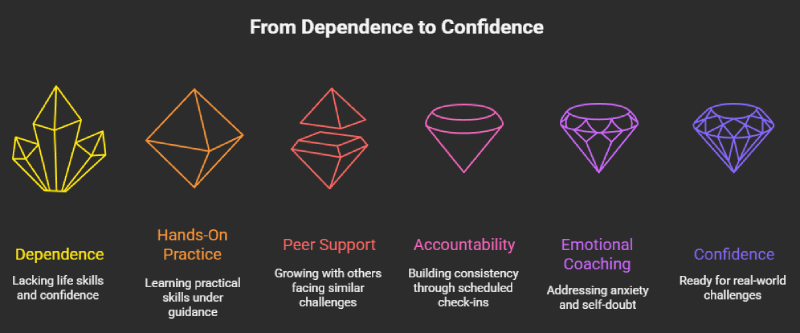
When your young adult joins a life skills program for young adults, they get:
Real-world practice. They cook actual meals. They manage real money. They attend actual job training. It’s not theoretical; it’s hands-on.
Peer support. They’re with other young adults facing similar challenges. Suddenly, they’re not the only one who doesn’t know how to do laundry. That normalizes the struggle and reduces shame.
Professional guidance. Clinicians and life coaches understand why your young adult is stuck. They address the underlying issues (anxiety, depression, low self-esteem) alongside the practical skills.
Consistent accountability. At home, you might remind them to shower for the hundredth time. In a program, daily structure and peer accountability work better than parental nagging ever could.
A pathway forward. Programs like those at At The Crossroads help young adults transition from the program into college, jobs, and independent living. It’s not just about the skills; it’s about building confidence and momentum.
Why Life Skills Programs for Young Adults Actually Work
The difference between a struggling 22-year-old and an independent one often isn’t intelligence or capability. It’s structure, accountability, and practice in a safe environment.
When your young adult joins a life skills program for young adults, they get:
Real-world practice. They cook actual meals. They manage real money. They attend actual job training. It’s not theoretical; it’s hands-on.
Peer support. They’re with other young adults facing similar challenges. Suddenly, they’re not the only one who doesn’t know how to do laundry. That normalizes the struggle and reduces shame.
Professional guidance. Clinicians and life coaches understand why your young adult is stuck. They address the underlying issues (anxiety, depression, low self-esteem) alongside the practical skills.
Consistent accountability. At home, you might remind them to shower for the hundredth time. In a program, daily structure and peer accountability work better than parental nagging ever could.
A pathway forward. Programs like those at At The Crossroads help young adults transition from the program into college, jobs, and independent living. It’s not just about the skills; it’s about building confidence and momentum.
What Happens in a Life Skills Program for Young Adults
At The Crossroads uses a three-step approach: educate, experience, and empower.
Educate means teaching the why behind the skill, not just the how. Your young adult learns why budgeting matters, how to create one, and what happens when they don’t.
Experience means doing it. They work with vocational training, attend social skills instruction, participate in community service, and build habits through repetition.
Empower means stepping back gradually. As they gain competence, they take on more responsibility. The goal is independence, not dependence on the program.
This structured environment works because it removes the emotional weight of family conflict while maintaining accountability.
The Cost of Waiting vs. The Cost of Action
Here’s what happens if your young adult stays stuck:
- Their confidence erodes further with each year of dependence
- The financial drain on your family continues indefinitely
- Siblings resent the attention and resources they receive
- Your marriage bears the stress of constant disagreement about how to handle it
- Your young adult’s future becomes increasingly uncertain
A life skills program for young adults requires an investment. But so does supporting a 30-year-old who still can’t manage basic tasks.
The families we work with at At The Crossroads often say the same thing: “We wish we’d done this sooner.”
Signs Your Young Adult Needs a Life Skills Program
Not every struggling young adult needs residential programming. But if your teen or young adult displays several of these signs, it’s time to explore options:
- Refuses basic self-care (showering, clean clothes, hygiene)
- No motivation to work or attend school
- Can’t handle minor setbacks or criticism
- Avoids all responsibility and blames others
- Isolated from peers or shows extreme social anxiety
- Struggles with depression, anxiety, or other mental health challenges
- You’re financially supporting them with no timeline for independence
- Family conflict around their situation is escalating
Next Steps: How to Help Your Young Adult
Start with an honest conversation. Your young adult likely knows something is off. Approaching this with curiosity instead of judgment opens the door.
Get a professional evaluation. A therapist or counselor can assess whether there’s an underlying mental health issue that needs attention first.
Research life skills programs for young adults. Look for programs that offer therapy alongside practical skills training, have experienced staff, and show real results.
Contact At The Crossroads. We’re based in St. George, Utah, but we accept young adults from across the country. Our transitional living program combines clinical support with hands-on life skills training. We’ve helped hundreds of families navigate this exact situation.
A call takes 15 minutes. You don’t need to have it all figured out. You just need to take the first step.
The Bottom Line
Your young adult isn’t broken. They’re not lazy. They’re stuck. And being stuck is actually a sign that something needs to change, not that they’re beyond help.
Life skills programs for young adults work because they address the whole person: the practical skills, the emotional barriers, the confidence gap, and the path forward. Your young adult can learn to cook, manage money, hold a job, and live independently. They just need the right environment and support to get there.
At The Crossroads is ready to help. We know what works because we’ve seen it happen hundreds of times.
Contact At The Crossroads to help your teen now. Call us at (866) 439-0354 or email [email protected]. We offer confidential consultations 24/7 and can help you figure out if our program is the right fit.
Recent Comments