
Life coaching for young adults is a structured, goal-focused partnership that helps 18-to-25-year-olds build the skills, habits, and confidence to live independently. Unlike therapy, it doesn’t diagnose or treat mental health conditions. Unlike parenting, it doesn’t set rules or enforce consequences. A life coach helps your young adult identify what’s holding them back, build accountability, and take consistent action toward their own goals.
You’ve probably seen the term used loosely online, sometimes alongside doubts about whether it’s worth the investment. Here’s what young adult life coaching actually involves, how it’s different from therapy and parenting, and when it’s the right next step.
What Coaching for Young Adults Actually Is
- Focused on forward movement, not diagnosis. A coach helps your young adult set direction and take the next step, rather than dig into why they’re stuck.
- Built on powerful questions. Instead of telling your young adult what to do, a coach asks what they want and what’s in the way, so the decision to change comes from them.
- Centered on accountability. Your young adult sets a goal, reports back on it, and works through what got in the way when they fall short.
- Time-limited and goal-focused. Coaching runs in defined blocks toward a clear outcome, not an open-ended relationship.
What Coaching for Young Adults Is NOT
- Not therapy a coach doesn’t diagnose or treat mental health conditions. If anxiety, depression, or trauma are present, therapy needs to run alongside coaching, not replace it.
- Not parenting a coach doesn’t set rules or enforce consequences. The relationship is a partnership, not an authority structure.
- Not cheerleading a good coach gives honest feedback, not empty encouragement, and names avoidance when it shows up.
- Not advising a coach helps your young adult think through decisions and own the outcome, rather than telling them what to do.
How Coaching for Young Adults Works in Practice
- Initial assessment: the coach learns what’s working, what’s stuck, and what your young adult actually wants.
- Goal setting: together they define a specific, measurable goal, from landing a job to building independent living habits.
- Action planning: the goal breaks into small, weekly steps instead of one overwhelming leap.
- Regular check-ins: weekly sessions track progress, troubleshoot obstacles, and adjust the plan.
- Building habits and systems: coaching reinforces the life skills training your young adult needs for independence, from money management to daily routines, following structured life skills training programs for young adults.
- Reflection and celebration: wins get acknowledged and setbacks become learning, which builds the confidence to keep going.
- Transition and closure: coaching ends once your young adult can sustain progress on their own.
Real example: A 21-year-old client who couldn’t get through a job interview worked with her coach for eight weeks. She rebuilt her resume, practiced interviewing, and landed a part-time job by week six, then used the same accountability system to build a daily routine around it.
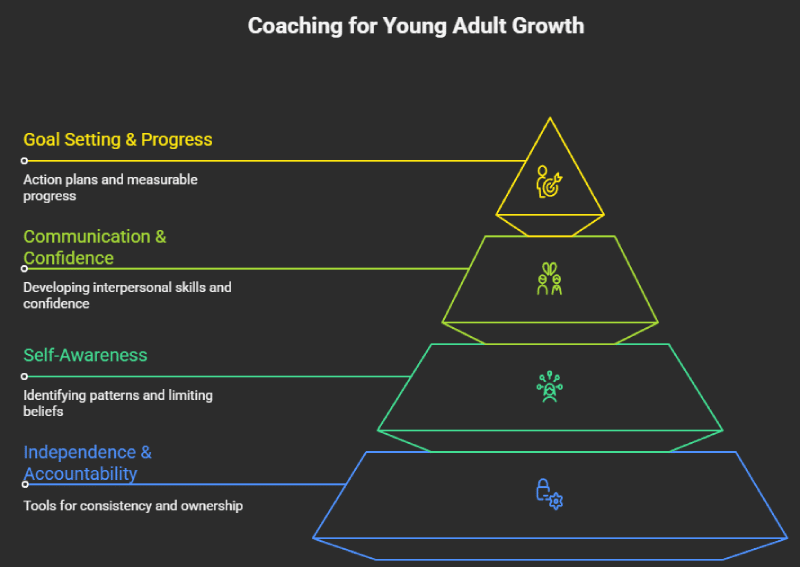
Types of Life Coaching for Young Adults
| Coaching Type | Focus | Best For |
|---|---|---|
| Career Coaching | Job skills, resumes, interviews, career direction | Young adults unsure about their path |
| Life Coaching | General independence, goals, motivation | Young adults stuck in multiple areas |
| Executive Function Coaching | Organization, time management, follow-through | Young adults with ADHD or planning challenges |
| Social Coaching | Relationships, communication, social skills | Young adults with social anxiety or isolation |
| College Coaching | Academics, applications, transition to college | Young adults considering or attending college |
| Financial Coaching | Money management, budgeting, financial independence | Young adults struggling with money |
For a closer look at what independence actually requires, see 11 Essential Life Skills for Independent Living and 10 Essential Life Skills Every Young Adult Needs to Learn.
When Coaching Is Right and When It Isn’t Enough
| Coaching Is the Right Choice When... | Coaching Isn't Enough on Its Own When... |
|---|---|
| Your young adult is functioning but stuck | Untreated mental health issues are present |
| They're open to feedback and willing to work | Active substance use is involved |
| They lack structure or accountability, not motivation | There's a long-standing failure-to-launch pattern needing a full program |
At The Crossroads combines coaching with therapy, life skills training, and a structured environment when a young adult needs more support than coaching alone can provide.
Frequently Asked Questions
What does a life coach for young adults actually do?
A life coach for young adults helps them set specific goals, builds an action plan, and holds them accountable through regular check-ins, focusing on real skills like job searching, money management, and daily structure.
Is life coaching the same as therapy?
No. Life coaching is action- and goal-focused, while therapy diagnoses and treats mental health conditions. Many young adults benefit from both at once, especially when anxiety or depression is part of the picture.
How long does life coaching for young adults typically last?
Most engagements run in defined blocks of a few months, ending once the young adult can sustain their goals and habits without weekly outside support.
When is coaching not enough on its own?
If a young adult has untreated mental health conditions, active substance use, or a long pattern of failure to launch, a structured program with therapy, life skills training, and supervision usually works better than coaching alone.
How is At The Crossroads’ approach different?
At The Crossroads combines life coaching with therapy, life skills training, and a structured environment, so young adults get accountability and clinical support together instead of coaching as a stand-alone service.
Recent Comments