

Depression is one of the most frequently misdiagnosed mental health conditions because its symptoms overlap with bipolar disorder, ADHD, PTSD, thyroid disorders, and even grief. For young adults, the risk is even greater, as depressive symptoms are often dismissed as stress or a normal phase of life. This guide explains why depression is commonly misdiagnosed, what conditions are often confused with it, and why a more comprehensive evaluation can make the difference between an inaccurate label and effective treatment.
Meet Depression, The Most Misdiagnosed Mental Illness In the World
Unlike physical illnesses like cancer or diabetes, mental illness is difficult to diagnose. And like the aforementioned physical maladies, mental illness is all too easy to misdiagnose as there are no physiological tests that can prove its manifestation. What’s worse? Depression (a dangerous mental illness and also a precursor to suicidal ideation) is the most misdiagnosed mental illness of all.
What Gets Misdiagnosed as Depression (and What Depression Gets Mistaken For)

Part of why depression is so often misdiagnosed is that it runs in both directions. Doctors sometimes label something else as depression when it isn’t, and just as often, they label depression as something else entirely. Both mistakes delay the right treatment, and for a young adult already struggling, that delay can cost months.
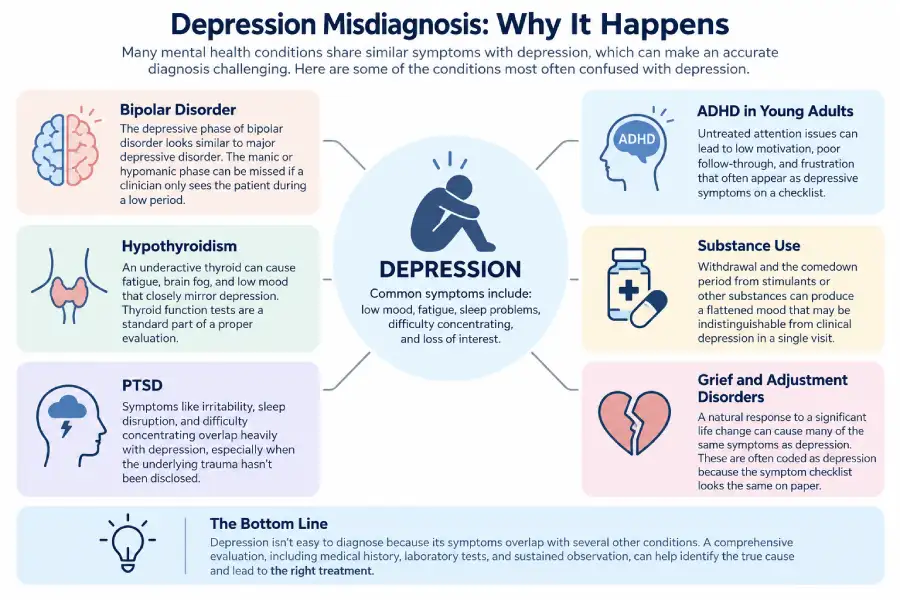
A handful of conditions commonly get mistaken for depression, or mistaken for it in reverse:
- Bipolar disorder: the depressive phase of bipolar looks nearly identical to major depressive disorder on its own, and the manic or hypomanic phase is easy to miss if a doctor only sees a patient during a low period.
- Hypothyroidism: an underactive thyroid produces fatigue, brain fog, and low mood that mirror depression closely enough that thyroid panels are considered a standard part of a proper workup.
- PTSD: irritability, sleep disruption, and difficulty concentrating overlap heavily with depressive symptoms, especially when the underlying trauma hasn’t been disclosed.
- ADHD in young adults: untreated attention issues often produce the same low motivation, poor follow-through, and frustration that read as depressive symptoms on a checklist.
- Substance use: withdrawal and the comedown period from stimulants or depressants both produce a flattened mood that can be indistinguishable from clinical depression in a single office visit.
Grief and adjustment disorders: a definition worth stating plainly: an adjustment disorder is a stress response to a specific life change that resolves as the person adapts, not a standalone mood disorder, but it’s frequently coded as depression because the symptom checklist looks the same on paper.
This is the real reason a single diagnostic conversation so often gets it wrong. A checklist can confirm that someone has low mood, poor sleep, and low energy. It can’t tell a clinician why. That distinction is exactly what a longer residential assessment is built to catch, and it’s the difference between treating the actual cause and treating a label.
Depression: By the Numbers
An article in Current Psychiatry sheds light on the shaded topic of depression misdiagnosis in one of their 2012 articles. According to their publication, 26 to 45% of patients – who were diagnosed with suffering from depression – failed to meet ‘the checklist’ of diagnostic criteria for a depressive illness and therefore, were not treated for their depression. While an article from 2009, discovered general practitioners only correctly identify depression in 47.3% of their cases. Additionally, findings also indicated that doctors mistakenly misdiagnose various mental illness for a depressive disorder.
The Good News About Depression
While it is often misidentified (or simply, unidentified altogether), the truth is that millions of mentally-ill Americans are correctly diagnosed and aptly treated for their psychological issues. With that being said, depression is still a very real and severe mental illness – misunderstanding it, or misdiagnosing a depressive disorder for something it is not, is still a serious problem that affects millions of more Americans.
Understanding the consequences of depression misdiagnosis is the first step to fixing this grave issue in our mental healthcare system.
Fortunately for parents of depressed young adults, there are facilities that are designed to treat severe depression, called residential treatment facilities. Unfortunately, these facilities are often misconceived as a rehab that exclusively treats drug and alcohol addiction. While residential treatment facilities do in fact treat addictions, they are also effective in therapeutically treating drug-free, depressed individuals.
“It ain’t what you don’t know that gets you into trouble. It is what you know for sure that just ain’t so.” – Mark Twain
NEW: Why This Matters More for Young Adults
Young adults face a particular version of this problem. Symptoms that would prompt a thorough workup in an adult, appetite change, withdrawal, sleep disruption, are frequently written off as normal turbulence: a rough semester, a breakup, “just being a young adult.” That assumption is exactly how a real depressive episode goes untreated for years.
In our experience working with young adults who arrive after a failed first attempt at treatment, the pattern repeats often enough to be predictable: a short outpatient visit produces a depression diagnosis and a prescription, the medication doesn’t work because the underlying issue was never depression alone, and the family concludes that treatment itself doesn’t work. It isn’t that treatment failed. The diagnosis was incomplete.
Anyone who has watched a young adult cycle through this, misdiagnosed, mismedicated, and no better six months later, understands why the diagnostic step deserves more time than a fifteen-minute appointment can give it.
Get The Best Treatment Out of Residential Programs
At The Crossroads is among the top residential treatment facilities in the nation. If you are the parent of a struggling young adult, trust in a treatment program that has served as a life catalyst for thousands of young men and women. Call us today at 1-866-439-0354.
How a Residential Setting Gets the Diagnosis Right

A single appointment gives a clinician a symptom checklist and very little else. A residential setting gives the clinical team weeks of direct observation: how a young adult sleeps without a phone to blame, how they respond to structure and the therapeutic approach to young adults our program uses day to day, and whether mood lifts, stays flat, or spikes once substances and unstructured time are removed from the picture. That kind of sustained observation is what separates an accurate diagnosis from an educated guess.
It’s also why family context matters. Research on sibling dynamics has shown that mental illness risk roughly doubles when a sibling relationship is dysfunctional, which is one more reason a full clinical picture, not just an isolated symptom checklist, produces a diagnosis that actually holds up.
Frequently Asked Questions
Why is depression the most misdiagnosed mental illness?
Depression shares its core symptoms, low mood, fatigue, poor sleep, trouble concentrating, with several other conditions, so a short appointment built around a symptom checklist often can’t distinguish between them. Studies have found that anywhere from a quarter to nearly half of people diagnosed with depression didn’t actually meet the full diagnostic criteria.
What is most commonly misdiagnosed as depression?
Bipolar disorder, hypothyroidism, PTSD, ADHD, and substance withdrawal are the conditions most frequently mistaken for depression, because each one produces the same low mood and low energy that depression does.
Can depression be misdiagnosed as something else?
Yes. Clinicians sometimes miss a genuine depressive episode entirely, particularly in young adults, by attributing the symptoms to stress, a phase, or normal life adjustment rather than a treatable mood disorder.
How long does it take to get an accurate diagnosis?
A single office visit rarely provides enough information. Diagnostic accuracy improves substantially with sustained observation over days or weeks, which is one reason residential assessment periods are longer than a typical outpatient intake.
What should I do if I think my young adult was misdiagnosed?
Ask for a second, more comprehensive evaluation, ideally one that includes enough observation time to rule out overlapping conditions rather than relying on a single checklist-based conversation.
At The Crossroads works with young adults whose symptoms often overlap across multiple mental health conditions. Comprehensive residential assessments allow clinicians to observe patterns over time instead of relying on a single office visit, helping families better understand the underlying causes of emotional and behavioral challenges.
Recent Comments