

A recent study among American young adults showed several things that they consider to be their “biggest problems.” One was neighborhood violence, another was poverty; they mentioned global warming. But the number one concern of this group of young people was the dissolution of families.
In the report on edutopia.org, it states, “Respondents consider the breakdown of the family to be the most pressing issue facing their generation today.” As families are facing more and more problems, it is evident that the toll it is taking on the generation is making its way into their daily lives. Which is understandable.
My parents were not divorced until I was over 30, but it still felt strange to me, even when I’d wanted the divorce. In a sad addition, my own four children are the product of divorce; my step-children are also from divorce, obviously, or I wouldn’t get to have them in my life. It’s a fine line, and a treacherous one. I can’t blame children for wanting their parents to stay together. Mine did.
My husband’s did. My little boy cried the day he found out I was moving and he would have two houses to live in. “But I want us all to be together,” he said. This feeling must not change as they get older, as the young adults now are still citing that as their number one stressor.
Do they look into the future, as I have, and wonder if staying married is even possible anymore? Do they think about what they thought their future would be and realize that it can never be quite like that again, for better or worse? Is it the worry over siblings, the uncertainty of two homes, or even having only one, because one of the parents went away? It’s a frightening prospect at any age, and can certainly hold a young adult back from pursuing their dreams, in all aspects. School, work, travel, relationships sometimes, more help such as counseling is needed. Sometimes, the parents can work together, married or not, to help their son or daughter move forward emotionally and physically.
Family breakdown is the top-ranked fear among American young adults today, ahead of neighborhood violence, poverty, and even climate change, according to the Edutopia survey cited below. For young adults specifically, that fear tends to surface as anxiety about trust, uncertainty about their own future relationships, and a reluctance to commit to school, work, or a partner while their family situation still feels unresolved.
How Divorce Affects Young Adults Emotionally

A young adult processing their parents’ divorce is rarely dealing with one feeling at a time. Anger, grief, and relief can show up in the same week, sometimes in the same conversation. What’s different at this age, compared to a younger child, is that they understand the adult stakes: money, housing, and the quiet fear that their own future relationships are somehow already compromised.
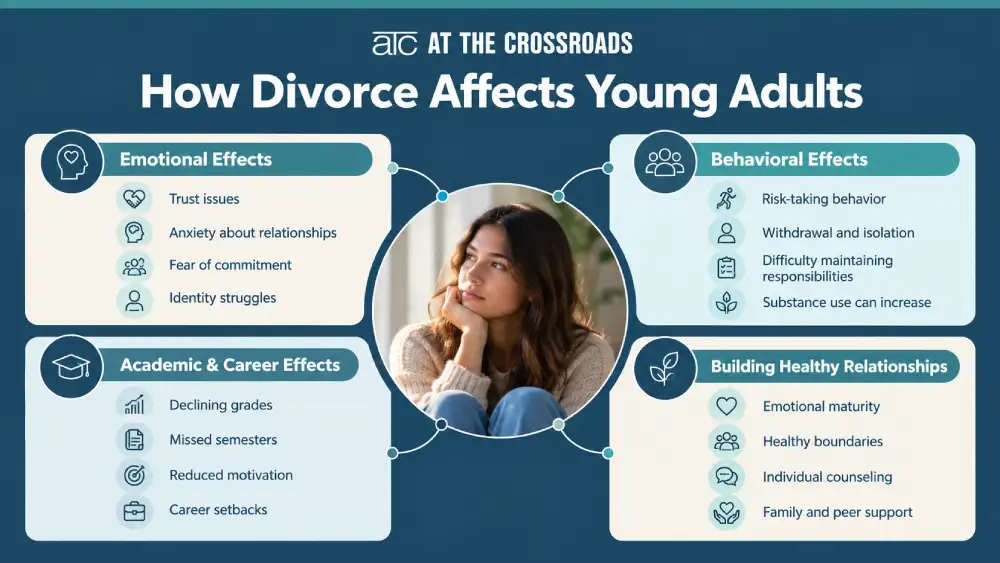
Trust issues are one of the most common long-term effects. When the two people a young adult has relied on for stability separate, it can quietly teach them that agreements, even serious ones, don’t always hold. That lesson can follow them into friendships, jobs, and romantic relationships long after the divorce itself is finalized.
Fear of commitment is closely related, and it’s one reason a young adult from a divorced family may seem to pull back right when a relationship, a lease, or a job offer starts to feel real. In our experience at At The Crossroads, this isn’t defiance or a lack of ambition. It’s a young adult protecting themselves from a version of loss they’ve already lived through once.
Identity struggles round out the picture. Adolescence and early adulthood are already about answering “who am I outside my family,” and a family that has visibly come apart can make that question feel unanswerable. A young adult may start to wonder whether they caused the split, whether they’re destined to repeat it, or whether they even know what a stable relationship looks like anymore.
The Behavioral and Academic Fallout of Family Breakdown

Family breakdown doesn’t stay contained to feelings. It shows up in report cards, job performance, and the choices a young adult makes when no one is watching.
Risk-taking as a coping mechanism
When anger or sadness has nowhere else to go, some young adults turn to risk-taking behavior instead, whether that’s substance use, reckless spending, or simply disappearing from responsibilities for a while. It’s rarely about the behavior itself. It’s usually an attempt to feel something other than helpless, or to feel nothing at all.
Academic and career stall-out
A drop in grades, a missed semester, or a job that quietly falls apart is often not laziness. Divorce pulls cognitive and emotional resources toward coping, which leaves less available for planning, follow-through, and motivation. This is one of the quieter ways family breakdown holds a young adult back from pursuing their dreams, exactly the pattern the existing page above already points to.
Withdrawal and isolation
Some young adults respond to family instability by pulling away from friends and routines altogether. A little space to process is healthy. Prolonged isolation is not, and it’s one of the clearer signs that a young adult needs more support than they’re getting from their current circle.
Breaking the Cycle: Building Healthy Relationships After Family Breakdown
Here’s what to realistically expect: a young adult does not simply “get over” their parents’ divorce on a timeline. What changes the outcome is whether they build new skills to replace the ones their family situation didn’t model for them.
Emotional maturity starts with naming a feeling before reacting to it. A young adult who can pause and say “I’m anxious because this reminds me of how things fell apart at home” is already doing something their parents may never have had the tools to do themselves.
Healthy boundaries are the second piece, and they cut both ways. A young adult needs permission to say no to a parent who wants them to take sides, and permission to let a new relationship move at its own pace instead of either rushing it or sabotaging it out of fear.
Neither of these skills is automatic, and they’re genuinely hard to build alone, particularly when the family model a young adult grew up with didn’t include them. This is exactly where structured support, whether that’s individual counseling, a program setting, or consistent family involvement even after a divorce, makes the difference between a young adult who stays stuck and one who moves forward.
How At The Crossroads Helps Young Adults Move Past Family Breakdown
At The Crossroads works with young adults who are stuck, not because they lack potential, but because family instability never gave them the chance to build the emotional skills that pursuing school, work, or independent life requires. That’s the gap our program is built to close.
For a young adult still working through the effects of a family breakdown, that can mean individual counseling to process what happened, family sessions that help parents, married or not, get back on the same page about supporting their son or daughter, and a peer environment where they’re not the only one whose family situation is complicated.
If your family is going through this now, a practical first step outside of therapy is building the kind of independence that makes a young adult feel like their future is still theirs to shape. Our guide on how to build credit as a young adult and our overview of group homes for young adults in Utah are both useful next reads if you’re weighing what level of support your son or daughter needs.
By the Numbers
- Family breakdown ranks as the #1 concern among American young adults, ahead of neighborhood violence and poverty (Edutopia).
- Adult children of divorced or separated parents show significantly higher rates of anxiety, depression, and risky behavior than peers from intact families (D’Onofrio & Emery, 2019, published via the National Institutes of Health).
- Parental divorce has been linked to a roughly 60% increase in teen births and a 40% higher likelihood of incarceration for the children involved, effects that researchers have traced into adulthood (U.S. Census Bureau, 2026).
These are cited as directional context on the scale of the problem, not as claims specific to any individual client of At The Crossroads.
FAQ: How Divorce Affects Young Adults
How does divorce affect young adults differently than younger children?
Young adults understand the adult-level consequences of divorce, including money, housing, and long-term family change, which younger children usually don’t process the same way. That awareness often shows up as anxiety about their own future relationships rather than the regression or clinginess seen in younger kids.
Can the effects of a parents’ divorce show up years later, even after a young adult has moved out?
Yes. Trust issues, fear of commitment, and identity struggles frequently surface well after the divorce is finalized, often when a young adult starts their own serious relationship, lease, or career decision and finds old patterns getting in the way.
Is it normal for a young adult to blame themselves for their parents’ divorce?
It’s common, but it isn’t accurate. Self-blame is one of the most frequent patterns we see, and it typically needs to be named and addressed directly in counseling rather than left to resolve on its own.
What are warning signs that a young adult needs more support than family and friends can provide?
Withdrawal from school, work, or relationships; new or escalating substance use; and a consistent inability to hold down responsibilities are all signs that a young adult may need structured, professional support rather than time alone.
Do young adults from divorced families struggle in their own relationships?
Many do report more caution, anxiety, or difficulty trusting a partner, but this is a pattern, not a certainty. With the right support, young adults from divorced families build stable, healthy relationships regularly.
What kind of help actually works for a young adult stuck on family breakdown?
A combination of individual counseling, family involvement where possible, and a peer environment tends to work better than any single approach alone, since family breakdown affects emotional, behavioral, and academic areas of a young adult’s life at the same time.
We know your child can succeed. You know your child can succeed. Somehow, we have to get them to believe that they, themselves, can succeed. At The Crossroads is a place where young adults can feel safe and secure and get the additional help that they need to move forward in life. To find out more, call us at (866) 439-0354.
Recent Comments