

Your 22-year-old put a hole in the bedroom door last month. Or maybe it hasn’t gotten physical, just slammed doors, screaming arguments, and a house that feels like it’s holding its breath. You’ve started wondering whether this is something they’ll grow out of, or something that needs real help.
Anger in a young adult rarely shows up the way people expect. It’s not always the loud blowup. Sometimes it’s icy withdrawal for days, sarcasm that cuts, or a hair-trigger temper that turns a minor disagreement into a screaming match. Whatever shape it takes in your house, if it’s starting to feel unsafe or unmanageable, you’re not overreacting by looking for help now.
This guide walks through why anger looks different in a young adult than it did at fifteen, how to tell ordinary frustration from something that needs treatment, and what an anger management program for young adults actually involves.
Why Anger Looks Different in Young Adults
At fifteen, anger usually looks like anger: slammed doors, raised voices, a fight that blows over by dinner. In an 18 to 25 year old, it often looks like something else entirely.
The prefrontal cortex, the part of the brain responsible for impulse control and weighing consequences, is still finishing its development into the mid-20s. Layer that onto the real pressures of this age (moving out, holding a job, dating, figuring out who they are) and anger becomes the emotion that leaks out when everything else feels unmanageable. It shows up as sarcasm, stonewalling, sudden explosiveness over small things, or a controlled coldness that does just as much damage as a shouting match.
Healthy Anger vs. a Real Problem
Anger itself isn’t the problem. Everyone gets angry. What matters is what happens next.
| Healthy Anger | A Real Problem |
|---|---|
| Rises in proportion to what caused it | Intensity out of proportion to the trigger |
| Gets expressed, then passes | Lingers for hours or days |
| Doesn’t damage people or property | Involves threats or damage |
| Can still hear the other side once things cool down | Shuts down any ability to listen or de-escalate |
| Followed by normal repair | Followed by shame or minimizing what happened |
Recognizing the Warning Signs Anger Has Become a Bigger Problem
Occasional frustration is normal. What separates a bad day from a genuine anger problem is pattern and intensity: outbursts that are disproportionate to the trigger, physical aggression toward people or property, threats that leave family members afraid in their own home, and an inability to calm down without the situation escalating further. Chronic irritability that shows up across settings, not just at home, is another marker worth taking seriously.
Anger dysregulation in young adults is frequently tied to an underlying mental health condition rather than a standalone behavior problem. According to 2022 data from the National Survey on Drug Use and Health, 36.2 percent of adults aged 18 to 25 experienced any mental illness that year, and 11.6 percent experienced a serious mental illness, both notably higher than older age groups (National Institute of Mental Health). In our experience working with young adults at Crossroads, the anger that brings a family to us is almost never the whole story. It is usually sitting on top of anxiety, depression, unprocessed trauma, or substance use that hasn’t been named yet.
A useful gut check for parents: if you have started managing your own behavior around your young adult’s moods, walking on eggshells, avoiding certain topics, hiding car keys, that is a sign the anger has outgrown what a family can safely manage on its own.
riggers Young Adults Commonly Experience
Anger rarely appears out of nowhere. A handful of triggers show up again and again at this age: financial stress from not knowing how to manage money or find stable work, romantic relationships that end badly or repeat an unhealthy pattern, comparison and rejection playing out constantly on social media, family conflict around independence and being treated like a teenager instead of an adult, and academic or career setbacks that feel like proof of failure.
None of these excuse harmful behavior, but naming the actual trigger, rather than treating the anger as random, is usually the first real progress a family sees.
Emotional Regulation: The Skill Underneath the Outburst
Most anger problems in young adults aren’t actually about anger. They’re about emotional regulation: the ability to notice a feeling building, name it, and choose a response instead of being run by it.
Without that skill, frustration goes from zero to explosive in seconds because there’s no pause in between to work with. Emotional regulation is learnable at any age, but it usually won’t build itself. It takes practice, feedback, and, for many young adults, direct coaching from a therapist who can catch the moment before the escalation and slow it down enough to examine.
CBT Techniques That Help With Anger
Cognitive behavioral therapy targets the thought patterns that turn a minor frustration into a major reaction. A young adult prone to anger often has what’s called hostile attribution bias, reading neutral situations (a slow reply, a raised eyebrow) as an attack.
CBT works by slowing down that interpretation: catching the automatic thought (“they’re disrespecting me”), testing whether it’s actually true, and replacing it with a more accurate read before the body reacts. Over time, this rewires the trigger-to-explosion pathway rather than just managing the explosion after it starts.
DBT Skills That Help With Anger
Dialectical behavior therapy adds tools for the moments when the body is already flooded and thinking clearly isn’t an option yet. The TIPP skill (temperature, intense exercise, paced breathing, progressive muscle relaxation) works directly on the physical intensity of anger, cooling the nervous system down fast enough to re-engage the thinking brain.
The STOP skill (stop, take a step back, observe, proceed mindfully) builds a deliberate pause into a pattern that used to have none. These aren’t abstract concepts. They’re specific, practicable steps a young adult can use in the fifteen seconds before a reaction becomes a regret.
What an Effective Program Actually Includes
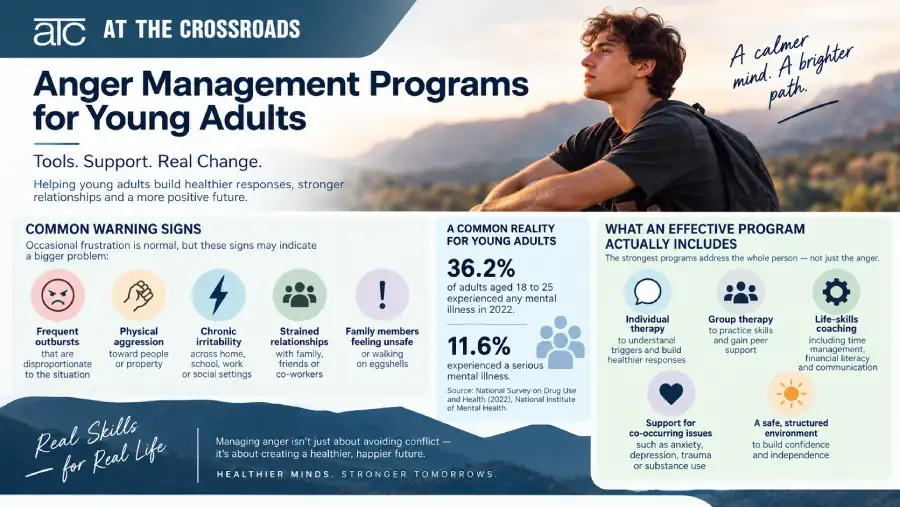
Not all anger management support looks the same, and the format matters. A once-a-week outpatient session can help a young adult who is otherwise functioning well but needs better coping tools. A young adult whose anger has already cost them a job, a relationship, or their housing usually needs something more immersive.
The programs that produce lasting change tend to combine several pieces rather than relying on anger management alone. Individual therapy, typically cognitive behavioral therapy or dialectical behavior therapy, builds the skill of naming and interrupting the anger cycle before it peaks.
Group therapy lets young adults practice de-escalation and communication with peers who understand what they are working through, not just clinical staff. Family involvement matters because anger patterns learned at home often need to be addressed with the whole family system, not the young adult in isolation.
A structured daily routine with consistent expectations helps too, since unpredictable anger often thrives in unstructured days. Aftercare planning that starts well before discharge rounds it out, so the skills built during treatment survive the transition back to independent life.
A program that offers only the first item on that list is treating a symptom. A program built around all five is treating the pattern.
When Residential Treatment May Help
Outpatient anger management works well when a young adult is functioning reasonably well otherwise and just needs better tools. Residential treatment becomes the better fit when anger has already cost a job, a relationship, or housing, when previous outpatient therapy hasn’t held, when anger is combined with substance use or another untreated condition, or when family members no longer feel physically or emotionally safe at home. In those situations, our therapeutic approach gives a young adult the daily practice and immediate feedback that a once-a-week session can’t provide.
How to Choose the Right Program for Your Young Adult

Choosing a program is easier when you know what to compare. A few questions worth asking before you commit: Is the program licensed and accredited for the level of care it provides, and can staff explain their credentials without hesitation? What specific therapeutic approaches do clinicians use, and how do those match your young adult’s actual triggers, not just a generic anger diagnosis? What is the realistic length of stay, and what does the program consider a successful discharge? How involved will your family be during treatment, and what does that look like week to week? What happens after discharge, and who is responsible for keeping that plan on track?
If you are also weighing less structured options, our guide to group homes for young adults in Utah walks through how that level of care differs from a more therapeutic, structured program like ours, and which young adults tend to do better in each setting.
Cost transparency matters too. A program that hedges on pricing or discharge timelines until you have already committed is a red flag worth taking seriously.
Life Skills Are Part of Anger Management, Not Separate From It
Anger in young adults rarely exists in a vacuum. It often travels with the same gaps that show up in failure-to-launch cases generally: not knowing how to hold a job, manage money, or navigate everyday social situations without friction. That is why life skills coaching runs alongside anger management here rather than after it.
Two examples show up constantly. Financial stress is a common anger trigger for young adults who have never learned the basics, which is part of why resources like our beginner’s guide to building credit as a young adult matter as much as therapy sessions. And a surprising number of blowups start with small social frictions, an interruption, a perceived slight, that used to be smoothed over with basic courtesy. Our piece on couth, a word young adults of this generation ought to know and understand gets into why that specific social skill has eroded and what rebuilding it looks like in practice.
Treating anger without touching these adjacent skills tends to produce a young adult who can name their feelings accurately and still can’t hold down a job or a friendship.\
Self-Assessment: Is My Anger a Problem?
For the young adult reading this, or a parent going through it with them:
- I’ve said or done things in anger that I regretted within the hour.
- People around me have started walking on eggshells.
- I’ve damaged property or threatened someone during an argument.
- I stay angry long after the situation itself is over.
- I’ve lost a job, relationship, or friendship because of how I handled anger.
- Apologies afterward don’t seem to change the pattern.
A few “yes” answers doesn’t mean something is broken beyond repair. It means the pattern is worth addressing directly rather than waiting for it to resolve on its own.
Parent Observation Checklist
- Outbursts are disproportionate to what triggered them.
- You’ve changed your own behavior to avoid setting them off.
- Threats or aggression have made you or someone else feel unsafe.
- The anger shows up in more than one setting (home, work, socially).
- Previous conversations or consequences haven’t changed the pattern.
- You suspect something else, anxiety, depression, substance use, is underneath it.
Two or more checked boxes is a reasonable point to bring in a professional. Any item involving safety means reaching out now.
What Happens Next?
If several of these sound familiar, the next step is a conversation, not a commitment. Reach out to our admissions team (enlazar a Contact Us) and describe what you’re seeing. Our team will ask questions about the specific pattern, not just the label of “anger,” and help you understand whether outpatient support or a more structured program like ours fits. There’s no obligation attached to that first call, and it typically takes less time than most parents expect to get a clear answer.
Frequently Asked Questions About Anger Management Programs for Young Adults
Is anger management for young adults different from programs for teenagers?
Yes. Programs designed for 18 to 25 year olds account for a different set of pressures, moving out, employment, romantic relationships, and identity apart from parents, and treat clients as emerging adults rather than adolescents. A program built for teenagers, or one that treats a 22 year old the same as a 15 year old, tends to miss what’s actually driving the anger at this age.
How long does an anger management program for young adults typically last?
Most structured programs run between 30 and 90 days for the initial phase, though timelines vary based on the severity of the anger pattern and any co-occurring conditions. Programs built around lasting change, rather than quick stabilization, usually plan for step-down support after the initial stay rather than a hard discharge date.
What is the difference between anger management therapy and a residential anger management program?
Outpatient anger management therapy is typically one weekly session focused on coping skills, while a residential program removes the young adult from their usual environment and combines individual therapy, group work, and daily structure around the clock. Residential care is generally the better fit when anger has already led to job loss, legal trouble, or family safety concerns.
Can anger management help if my young adult also struggles with anxiety or depression?
Yes, and addressing anger alone while ignoring an underlying condition rarely holds up long term. Effective programs screen for co-occurring anxiety, depression, and trauma at intake and build treatment around whatever is actually driving the anger, not just the anger itself.
Will my family be involved in the program, or is it just individual treatment for my young adult?
The strongest programs build in regular family sessions and communication check-ins rather than treating the young adult in isolation. Anger patterns are frequently learned or reinforced within the family system, so lasting change usually requires the whole family to adjust alongside the young adult.
What happens after my young adult finishes the program?
A solid aftercare plan should be in place before discharge, covering ongoing therapy, family agreements, and a plan for returning to work, school, or independent living. Programs that treat discharge as the finish line rather than a transition tend to see higher relapse into old anger patterns within the first few months.
Recent Comments