

You’ve heard the term “life coach for young adults” mentioned. Maybe someone recommended it for your teen. But you’re not sure what it actually is. Is it therapy? Is it a tutor? Is it just someone motivating your young adult to try harder?
Life coaching for young adults is its own thing. It’s not therapy. It’s not tutoring. It’s not parenting. It sits in its own space, and that space is powerful for young adults who are stuck.
A life coach for young adults helps your teen identify what’s holding them back, set achievable goals, build the skills and habits they need, and move toward independence. Coaching is action-focused. It’s about doing, not just talking. It’s about building momentum and confidence through small wins.
This article explains what coaching for young adults actually is, how it works, what it’s not, and whether it might be what your young adult needs right now.
What Coaching for Young Adults Actually Is
Understanding what coaching is helps you know if it’s right for your teen.
Coaching for young adults focuses on movement.
Your young adult is stuck. They’re not moving toward independence. A coach helps them identify what’s blocking them and creates a plan to move forward. The emphasis is on action, not analysis.
A life coach for young adults asks powerful questions.
Instead of telling your teen what to do, a coach asks questions that help them discover their own answers. “What’s holding you back? What would it feel like to move forward? What’s one small step you could take this week?” This approach builds autonomy.
Coaching for young adults builds accountability.
Your teen sets a goal. They report back. Did they do it? What happened? What’s next? This external accountability often helps young adults follow through when they struggle with self-motivation.
A life coach for young adults helps create systems and habits.
Coaching isn’t just motivation talks. It’s practical. Your coach helps your teen design a morning routine. They help create a job search system. They build habits that support the goal.
Coaching for young adults is time-limited and goal-focused.
Unlike therapy which can be open-ended, coaching has a clear endpoint. You start with a goal. You work toward it. When you reach it, coaching ends. This creates urgency and focus.
What Coaching for Young Adults Is NOT
Equally important is understanding what it’s not.
Coaching is not therapy.
A coach doesn’t diagnose or treat mental health conditions. If your teen has depression, anxiety, or trauma, they need a therapist first. Coaching can happen alongside therapy, but coaching alone isn’t treatment.
Coaching is not parenting.
A coach doesn’t parent your teen. They don’t set rules or enforce consequences. They guide and support, but the relationship is different from parent-child.
Coaching is not cheerleading.
“You can do it! Go, go, go!” Motivational speeches feel good temporarily but don’t create lasting change. Real coaching involves honest feedback and challenge. A good coach tells your teen what they need to hear, not just what they want to hear.
Coaching is not advising.
A coach doesn’t tell your teen what to do. “You should get a job.” “You should move out.” Instead, a coach helps your teen decide what they want and creates a path to get there. Autonomy matters.
Coaching is not fixing.
Your teen has problems. You want them fixed. A coach helps your teen solve their own problems. The process of solving is often more valuable than the solution itself.
How Coaching for Young Adults Works in Practice
Understanding the actual process helps you see if it’s right for your situation.
Initial assessment:
A life coach for young adults starts by understanding your teen. What’s working? What’s not? What do they want their life to look like? What’s blocking them? This assessment determines the coaching direction.
Goal setting:
Your teen identifies a goal. This could be getting a job, moving out, attending school, building social connections, or developing independence. The goal is specific and measurable.
Creating an action plan:
The coach and your teen work together to create a realistic plan. Not “get a job immediately.” But “update your resume this week, apply to three jobs next week, practice interviews the week after.” Small steps.
Regular check-ins:
Weekly or biweekly, your teen meets with the coach. They report on progress. They discuss obstacles. They adjust the plan. Accountability happens here.
Building habits and systems:
A coach helps your teen build the systems they need. Morning routine. Time management system. Job search system. Money tracking system. These structures support movement toward goals.
Reflection and adjustment:
As your teen moves forward, they reflect on what’s working and what isn’t. The coach helps them learn from experience. If something isn’t working, they adjust.
Celebration of wins:
As your teen reaches milestones, they celebrate. “You did it. You applied to five jobs. You got an interview. You went to the interview despite being nervous.” These wins build confidence.
Transition and closure:
When your teen reaches their goal or becomes self-sufficient, coaching ends. The coach helps your teen recognize their progress and their capability to continue moving forward independently.
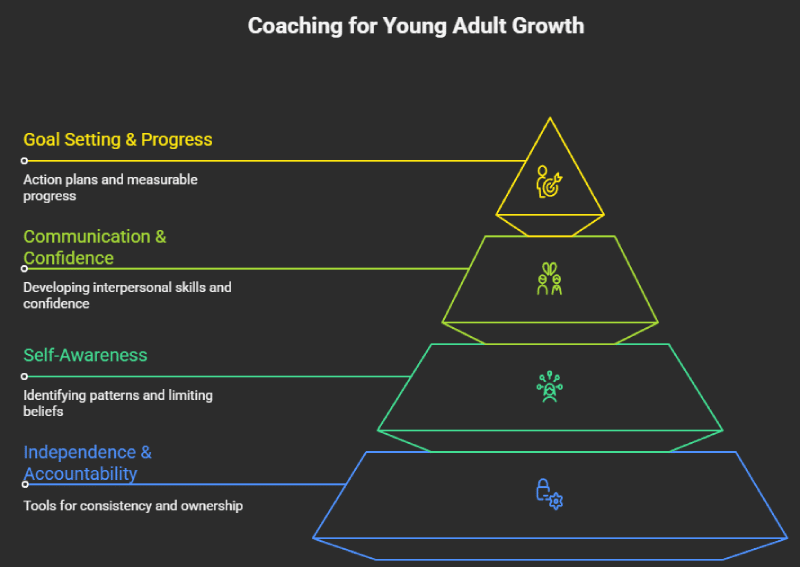
Types of Coaching for Young Adults
Different coaches specialize in different areas.
| Coaching Type | Focus | Best For |
|---|---|---|
| Career Coaching | Job skills, resume, interviews, career direction | Young adults unsure about work path |
| Life Coaching | General independence, goals, habits, motivation | Young adults stuck in multiple areas |
| Executive Function Coaching | Organization, time management, planning, follow-through | Young adults with ADHD or planning challenges |
| Social Coaching | Relationships, communication, social skills | Young adults with social anxiety or isolation |
| College Coaching | Academics, applications, transition to college | Young adults considering or attending college |
| Financial Coaching | Money management, budgeting, financial independence | Young adults struggling with money |
Some coaches specialize. Others do general coaching for young adults. At The Crossroads, life coaching is part of our broader program. We combine coaching with therapy, life skills training, and vocational support.
Real-World Example: How Coaching Works
Emma’s story:
Emma is 21. She’s stuck. She wants independence but doesn’t know how to get it. She’s tried therapy (helps somewhat). She needs more. Her mom finds a life coach for young adults.
Emma’s first session with the coach: “What do you want your life to look like in a year?”
Emma: “I want to have a job, live on my own, feel independent.”
Coach: “What’s stopping you right now?”
Emma: “I don’t know how to get a job. I’m scared of interviews. I don’t know where to look.”
Coach: “Okay. Let’s start with the first step. This week, let’s update your resume. Can you do that?”
Emma: “Yeah, I can do that.”
Week two: Emma updated her resume. The coach reviews it. They practice talking about Emma’s skills. The coach gives feedback.
Week three: Emma applies to three jobs. It’s scary, but she does it. One interviewer calls back.
Week four: Emma has her first interview. She’s terrified. But she goes. The interview goes okay. She doesn’t get the job. The coach helps Emma process it. “You did it. You survived. You learned something. Let’s apply to more jobs.”
Week six: Emma gets an interview offer for a job she wants. She gets it. She’s working.
Month three: Emma is working part-time. She’s saving money. She’s thinking about moving out in a few months.
The coach helped Emma move. Not by fixing her or telling her what to do. But by asking questions, creating accountability, building systems, and celebrating wins.
When Coaching for Young Adults Is the Right Choice
Coaching works best when:
Your young adult is functioning but stuck.
They’re not in crisis. They don’t have active mental health treatment needs. They’re just not moving forward. Coaching creates momentum.
Your teen is willing to work.
Coaching requires effort. Your young adult needs to be willing to try, even if they’re scared.
Your teen needs an outside perspective.
You’ve tried to help. It’s not working. An outside coach often breaks the logjam.
Your teen lacks structure or accountability.
They have good intentions but don’t follow through. A coach provides external accountability.
Your teen needs to develop independence.
They need to learn to make decisions, solve problems, and move forward without you. Coaching supports this.
Your young adult has a specific goal.
“I want to get a job.” “I want to move out.” “I want to go back to school.” Coaching is goal-focused.
When Coaching Isn’t Enough
Coaching works best as part of a comprehensive approach. If your young adult also has:
- Untreated mental health issues (anxiety, depression, trauma)
- Substance use struggles
- Severe motivation issues
- Significant life skills gaps
- Failure to launch symptoms despite previous coaching
Then coaching alone isn’t enough. A transitional living program or other intensive support becomes necessary.
At The Crossroads, we combine coaching with other supports. Your young adult gets life coaching for goal-setting and accountability. They also get therapy for underlying issues, life skills training, vocational support, and a structured environment. The combination works better than coaching alone.
Next Steps: Is Coaching Right for Your Teen?
Ask yourself:
Is my young adult functioning at a basic level? (Going to school or work, managing hygiene, leaving the house)
If no, therapy or more intensive support is needed first.
Are they willing to work on change?
If completely resistant, coaching won’t help. But if willing (even reluctantly), coaching can work.
Do they have specific goals?
Coaching is goal-focused. If your teen has no goals or direction, coaching helps identify them.
Have other approaches not worked?
If you’ve tried everything else, coaching offers a different angle.
Can you afford coaching?
Life coach for young adults fees vary. Some programs include it. Individual coaching can range from $50-150+ per hour.
If coaching seems like a fit, look for a coach who specializes in young adults. Ask about their experience. Ask for references. Make sure they understand your teen’s specific situation.
Contact At The Crossroads to help your teen now. Call (866) 439-0354 or email [email protected]. If your young adult needs coaching as part of a broader support system, we integrate life coaching into our program. We combine goal-focused coaching with therapy, life skills training, and structured support. Whether your teen needs coaching alone or as part of a comprehensive program, we can help you figure out the right approach. 24/7 confidential consultations available.
A good coach for young adults can be the catalyst your teen needs to move forward. Sometimes that’s the missing piece.
Recent Comments