

Key takeaways
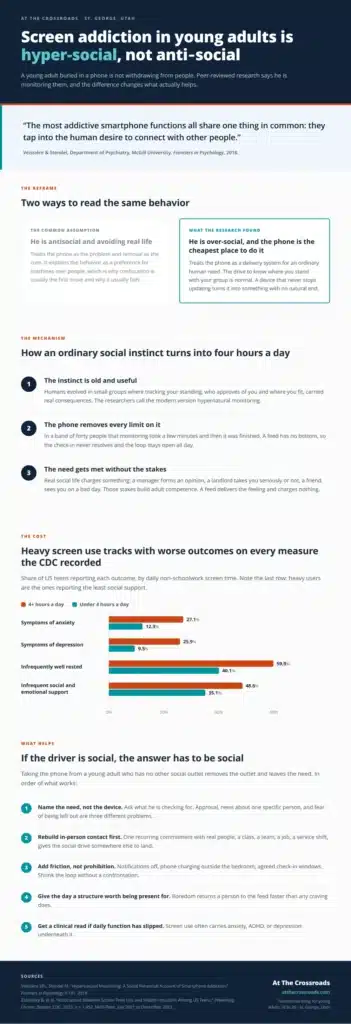
- A 2018 McGill study in Frontiers in Psychology found smartphone overuse is driven by a hyper-social need to monitor and connect with other people, not by a retreat from them.
- Screen addiction in young adults is better read as a misdirected social drive than as laziness.
- CDC data ties four or more daily hours of screen use to roughly 2.5 times the prevalence of depression symptoms.
- The response that works replaces the social reward. It does not simply remove the device.
Anti-Social Screen Obsession is Actually Due to Hyper-Social Need to Connect with Others Says New Study
While it’s no secret that we, as modern people, have an unhealthy fixation with our various electronic screens, a new study suggests that our obsession with technology actually comes from a pro-social desire to connect with others.
According to the Department of Psychiatry at McGill University, Canada’s findings which were recently published in Frontiers in Psychology, our anti-social proclivities to bury our face in our screens are not anti-social in nature at all, but rather, “hyper-social.”
More specifically, the study, led by Professor Samuel Veissiere, explains that the desire to monitor ourselves and others – aka, addiction to social media, etc. – actually ‘runs deep in our evolutionary past.’
According to Veissière, human social development evolved in a unique way:
“Humans evolved to be a uniquely social species and require constant input from others to seek a guide for culturally appropriate behavior. This is also a way for them to find meaning, goals, and a sense of identity.”
With the help of his team, Veissière, a cognitive anthropologist, was able to conclude that the most addictive aspects of smartphone functionalities all share one thing in common:
“They tap into the human desire to connect with others.”
To read more about this groundbreaking study, please click the link below:
A new study of dysfunctional use of smart technology finds that the most addictive smartphone functions all share a common theme: they tap into the human desire to connect with other people. The findings, published in Frontiers in Psychology, suggest that smartphone addiction could be hyper-social, not anti-social.
What Screen Addiction in Young Adults Actually Is
Screen addiction in young adults is compulsive use of phones, games, and social platforms to the point that work, school, sleep, and relationships suffer. What the McGill research adds is a motive. The pull is social, not chemical novelty. A young adult who scrolls for four hours is usually not hiding from people. He is checking on them.
Hypernatural monitoring is the term Veissiere and Stendel use for this: an evolved habit of tracking where a person stands with their group, now fed by a device that never runs out of updates. In a band of forty people that took a few minutes a day and then it was done. On a phone it never finishes.
The distinction changes what the problem is. A young adult who cannot put the phone down is rarely indifferent to real life. He is over-invested in a version of it that costs nothing to enter and nothing to leave. Families judging whether this has crossed a line usually start with the signs of internet addiction in young adults.
What the Research Says About Screen Use and Mental Health
A hyper-social explanation is not a reason to relax about screen time. The health data is blunt.
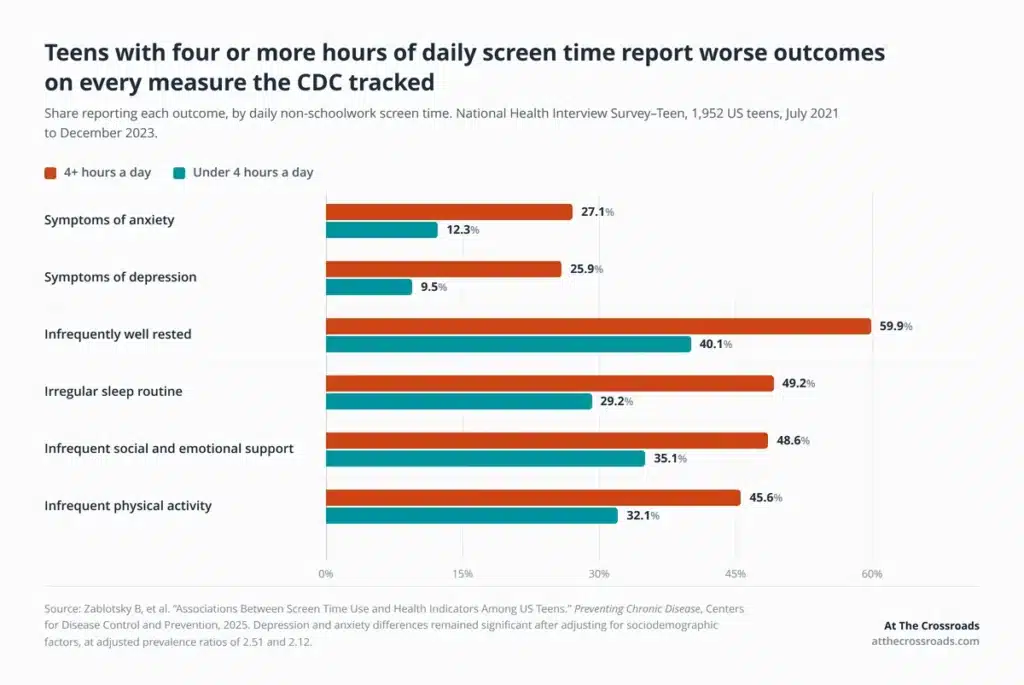
The CDC journal Preventing Chronic Disease published an analysis of 1,952 teenagers surveyed in the National Health Interview Survey between July 2021 and December 2023. Just over half, 50.4 percent, reported four or more hours of non-schoolwork screen time a day. Within that group, 25.9 percent showed symptoms of depression against 9.5 percent of low-screen peers, and 27.1 percent showed anxiety symptoms against 12.3 percent.
| Outcome reported | 4+ hours a day | Under 4 hours a day |
|---|---|---|
| Symptoms of anxiety | 27.1% | 12.3% |
| Symptoms of depression | 25.9% | 9.5% |
| Infrequently well rested | 59.9% | 40.1% |
| Irregular sleep routine | 49.2% | 29.2% |
| Infrequent social and emotional support | 48.6% | 35.1% |
| Infrequent physical activity | 45.6% | 32.1% |
One finding lines up directly with the McGill model. Heavy screen users were more likely to report infrequent social and emotional support, 48.6 percent against 35.1 percent. The device answers a social need without meeting it. Pew Research Center found in April 2025 that 45 percent of teens say they spend too much time on social media, up from 36 percent two years earlier.
Why Hyper-Social Screen Use Stalls a Young Adult’s Launch
Here is the part the research does not spell out, and the part we see most often at At The Crossroads. A phone can satisfy the social drive Veissiere describes while asking nothing that builds an adult life.
Real social life carries stakes. A shift at work means a manager forms an opinion. A call with a landlord means being taken seriously or not. A friendship made in person means being known on the bad days too. Those stakes are exactly what produce the skills of independence, and a feed strips all of them out while still delivering the feeling of being socially engaged.
In our work with young adults in transitional living, that trade is what stalls a launch. The social need gets met, so the motivation to face harder social ground never arrives. Students often show up fluent in group chats and unsure how to talk to a supervisor, which is the practical case for teaching couth, the polish and manners young adults of this generation are quietly missing.
The same pattern shows up financially. Money is a social act involving landlords, employers, and lenders, which is why learning how to build credit as a young adult tends to move alongside social confidence rather than ahead of it.
How to Redirect the Social Drive Instead of Cutting Screen Time
Veissiere’s own conclusion was an optimistic one. If the driver is social, the fix is social. Taking a phone from a young adult who has no other social outlet removes the outlet and leaves the need.
- Name the need, not the device. Ask what he is checking for. Approval, news about one specific person, and fear of being left out are three different problems.
- Rebuild in-person contact first. One recurring commitment with real people, a class, a team, a job, a service shift, gives the social drive somewhere else to land.
- Add friction, not prohibition. Notifications off, phone charging outside the bedroom, and agreed check-in windows shrink the monitoring loop without a confrontation.
- Give the day a structure worth being present for. Boredom returns a person to the feed faster than any craving does.
- Get a clinical read if daily function has slipped. Screen use often carries anxiety, ADHD, or depression underneath it.

When a young adult cannot hold that structure at home, a supervised setting holds it for him. That is the daily work inside group homes for young adults in Utah, where routine, staff, and peers take over the role the phone was playing.
“There is a lot of panic surrounding this topic,” says Professor Samuel Veissière, from the Department of Psychiatry at McGill University, Canada. “We’re trying to offer some good news and show that it is our desire for human interaction that is addictive — and there are fairly simple solutions to deal with this.”
To read the full article, click here.
Frequently Asked Questions About Screen Addiction in Young Adults
What are the signs of screen addiction in a young adult?
The clearest signs are functional rather than hourly: missed work or class, sleep pushed past 2 a.m., irritability when the phone is out of reach, and dropped in-person plans. Two or three of these holding for a month matters more than any screen time total.
How do you break screen addiction in adults?
Replace the social reward before removing the device. One recurring in-person commitment, notifications off, the phone out of the bedroom, and defined check-in windows work better than a ban. Abrupt removal usually fails because it takes the outlet and leaves the need.
What are the negative effects of screen time on young adults’ health?
CDC data links four or more daily hours of screen use to roughly 2.5 times the prevalence of depression symptoms and about twice the prevalence of anxiety symptoms. Heavy users also report worse sleep routines, less physical activity, and less social support.
Is there a connection between ADHD and phone addiction?
Yes. Trouble sustaining attention on low-stimulation tasks makes a fast-changing feed unusually rewarding, and weaker executive function makes stopping harder. Phone overuse in a young adult with ADHD is often a symptom being self-managed rather than a separate addiction.
Is screen addiction anti-social or hyper-social?
Hyper-social, according to the 2018 McGill study. Veissiere and Stendel found the most addictive smartphone functions all tap the human drive to monitor and connect with other people, making the behavior an overdriven social instinct rather than a retreat from society. More on the skills behind a launch is collected on the At The Crossroads blog.
Recent Comments