

Key takeaways
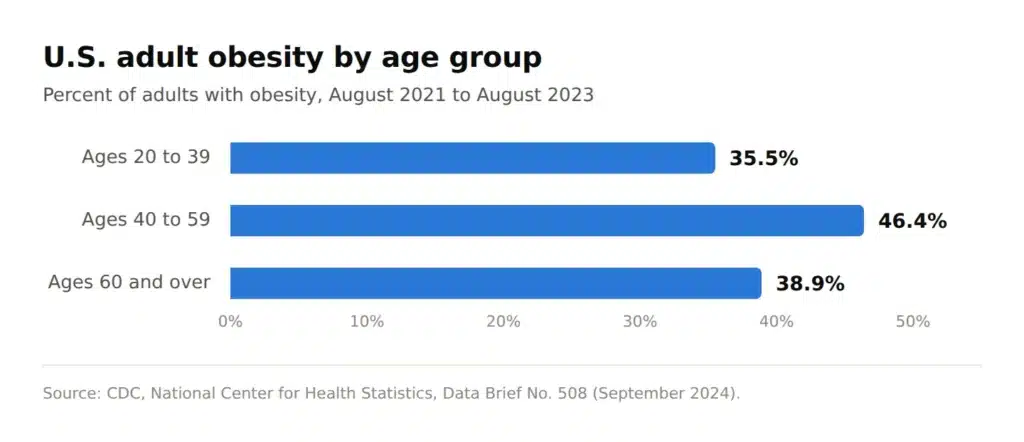
35.5% of U.S. adults ages 20 to 39 have obesity, and 46.4% of adults ages 40 to 59 (CDC, August 2021 to August 2023).
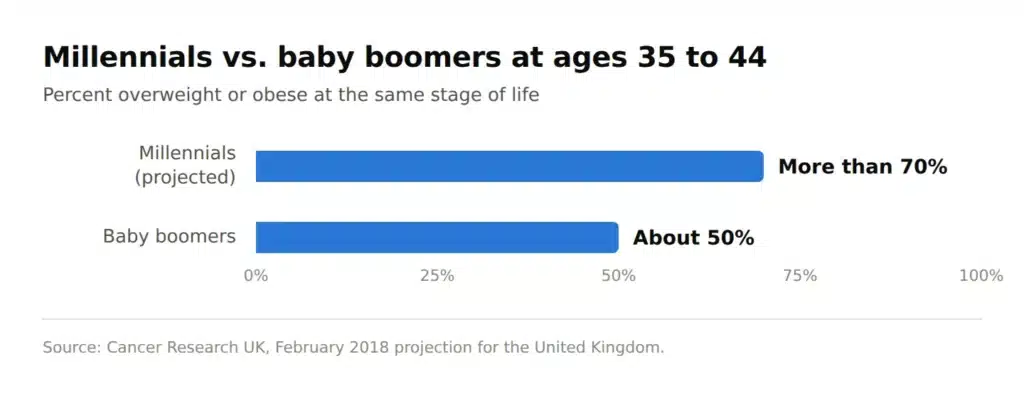
More than 70% of millennials are projected to be overweight or obese by ages 35 to 44, against roughly 50% of baby boomers (Cancer Research UK).
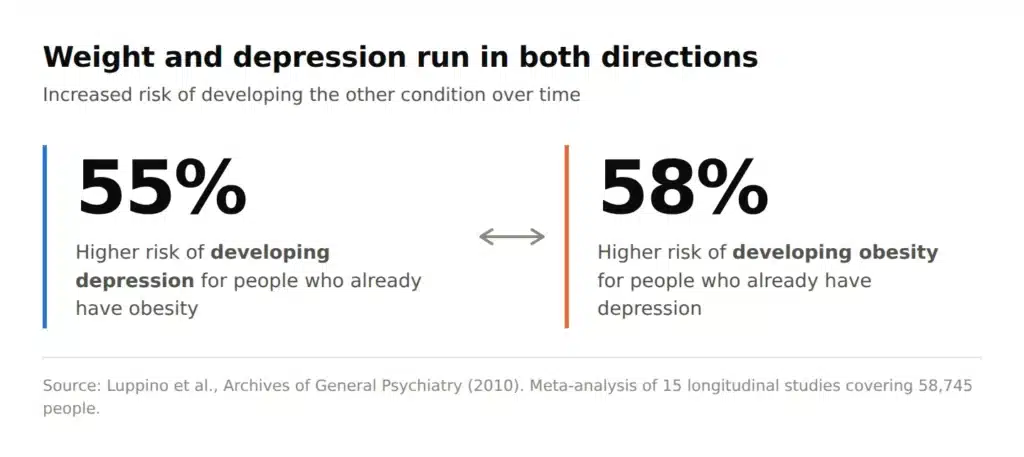
Obesity raises the risk of later depression by 55%. Depression raises the risk of later obesity by 58%.
In young adults, weight rarely travels alone. It arrives with anxiety, isolation, and stalled independence.
Obesity is becoming a growing problem nationwide and Millennials seem to leading the pack when it comes to obesity rates.
Yet, despite the health risks and mortality rates for those who are obese, many young adults seem relatively unconcerned. Why is it that so many Millennials aren’t taking this disease seriously? And, what can you do if you are concerned about your adult child’s health?
Obesity’s Impact on Millennials
Millennial obesity is the elevated rate of obesity among adults born between 1981 and 1996, a generation that reached adulthood carrying more weight than any cohort before it. Roughly 35.5% of Americans ages 20 to 39 and 46.4% of those ages 40 to 59 now meet the clinical threshold for obesity, according to CDC data collected between August 2021 and August 2023. The concerning part is not the number on its own. It is how early this generation arrived at it.
According to the Centers for Disease Control, the obesity rate for Millennials has tripled since its rate of just 5.7% in 1976 and 1980. This is, in part, due to the changing habits of this generation, including the increase in electronics use, as well as decline in exercise. Yet, while obesity is being looked at by some as more of a result of a generation’s conditioned behavior, it is so much more than that.
A study published online in the Journal of Business and Psychology stated that the Millennial generation’s tendency toward obesity will “negatively impact their productivity and resulting economic prosperity.” As parents, this means that the young adults we raised will not just experience increased health risks from being obese (and increased mortality rates at a younger age), but they will have trouble in the working world as well.
What the Latest Numbers Say About Millennial Obesity
The clearest way to read millennial obesity is to compare generations at the same age rather than look at one snapshot.
Cancer Research UK estimated in 2018 that more than seven in ten millennials would be overweight or obese by the time they reached 35 to 44. At that same stage of life, about half of baby boomers were. The gap between those two figures is the story.
A May 2026 review in Population Studies by researchers at UCL and Oxford found the same pattern and named it generational health drift. Across 51 British birth cohort studies covering people born between 1946 and 2000, childhood overweight and obesity were highest among Gen Z, and midlife diabetes nearly doubled, from 3.1% in baby boomers to 5.9% in Gen X.
The researchers were direct about the cause. Genetics did not change in forty years. The environment did: the food supply, screen time, and how little of daily life now asks the body to move.
But What are the Other Side Effects of Obesity?
Young adults who are dealing with obesity are not only putting themselves in danger of physical health risks, but mental ones as well. It’s not uncommon to experience co-occurring issues and disorders when it comes to being severely overweight, and as young adults use food as a coping mechanism, they fail to the rest of all the positive resources within themselves. This creates imbalance, low self-confidence, depression, anxiety, and may even lead Millennials to experiment with drugs and alcohol as a means of escape. The psychological effects of obesity can be just as damaging as the physical ones, and as a serious disease that is taking over a generation, it’s time something is done about it.
Why Weight and Mental Health Rise Together in Young Adults
The section above mentions food used as a coping mechanism. The evidence behind that is stronger than most parents expect, and it runs in both directions.
A meta-analysis of 15 longitudinal studies covering 58,745 people, published in Archives of General Psychiatry, found that people with obesity had a 55% higher risk of developing depression over time. People with depression had a 58% higher risk of developing obesity.
Bidirectional risk means treating only the weight, or only the mood, leaves the other one running. That loop pulls tighter in the young adult years, when identity, dating, first jobs, and body image all arrive at once. The UCL review found 22% of Gen Z in their early twenties reported a long-standing mental health condition, double the 10% recorded for millennials at the same age.
In our work with young adults ages 18 to 25, the families who see real movement are the ones who stop treating weight and mental health as two separate projects.
What Obesity Costs a Young Adult’s Independence
There is a practical layer here that gets far less attention than the medical one.
Research by Barkin and colleagues in the Journal of Business and Psychology concluded that as millennials entered the workforce, rising obesity across their generation would likely weigh on productivity and long-term earnings. Missed days, lower energy, and the confidence cost of walking into a room feeling judged compound quietly over a career.
For a young adult already struggling to launch, that pressure lands on top of everything else. Weight becomes one more reason not to apply, not to go out, not to try. The same avoidance shows up in the ordinary adult skills nobody formally teaches, such as how to build credit as a young adult and the everyday manners and self-presentation that decide a first impression.
Health and independence are not separate projects. Progress on one usually pulls the other forward.
Four Conversations That Work Better Than Ultimatums
Most parents already know that pressure backfires. What is less obvious is what to say instead.
- Lead with function, not appearance. Ask about energy, sleep, and stamina. Those are observations rather than judgments, and they open a door that comments about weight close.
- Name the loop out loud. Saying “I wonder whether the low mood and the eating are feeding each other” hands your young adult language for something they already sense.
- Offer one appointment, not a plan. A single visit to a physician or therapist is a decision they can say yes to. A twelve-month overhaul is not.
- Ask what they want their twenties to look like. Motivation from their own goals holds up. Motivation borrowed from a parent runs out.
When the pattern has lasted years rather than months, and the daily basics have stopped happening, structured settings such as group homes for young adults in Utah give a young adult accountability and clinical support at once.
Frequently Asked Questions About Millennial Obesity
Is Gen Z more obese than millennials?
Not yet on adult prevalence, but Gen Z started earlier. CDC data puts obesity at 35.5% for adults ages 20 to 39. The 2026 UCL review found childhood overweight and obesity were highest in Gen Z, which suggests they may overtake millennials as they age.
Why is the obesity rate so high among millennials?
Millennials were the first generation raised with cheap ultra-processed food, screens at home and at work, and neighborhoods built around driving. The UCL researchers attribute the shift to preventable environmental exposures rather than genetics.
Are 75% of Americans overweight?
Close. CDC FastStats reports 72.4% of adults age 20 and older were overweight, including those with obesity, between August 2021 and August 2023. Obesity alone accounts for 40.3%.
Does obesity cause depression in young adults?
The relationship runs both ways. Obesity is associated with a 55% higher risk of developing depression, and depression with a 58% higher risk of developing obesity, in a meta-analysis of 58,745 people.
When should parents seek professional help?
When weight is paired with withdrawal, missed school or work, or substance use for longer than a few months. At that point it is a pattern rather than a phase, and it responds better to structure than to willpower.
What a Parent Can Do to Help
If your young-adult child is having trouble controlling their weight and is experiencing additional side effects as a result, it should be comforting to know that professional help is available. As a residential treatment center created to help young adults transition successfully into adulthood, At the Crossroads provides a therapeutic environment that can address their individual needs and create a better path for their future. They are not alone in their struggles, and At the Crossroads can help.
More for parents of young adults: we write regularly about independence, mental health, and the transition into adulthood on the At The Crossroads blog. If anything here sounded familiar, that library is a reasonable place to start.
At The Crossroads is an Independent Living Program designed to help young adults ages 18-25 to become successful, self-sustaining individuals. To find out more, call us at (866) 439-0354.
Recent Comments